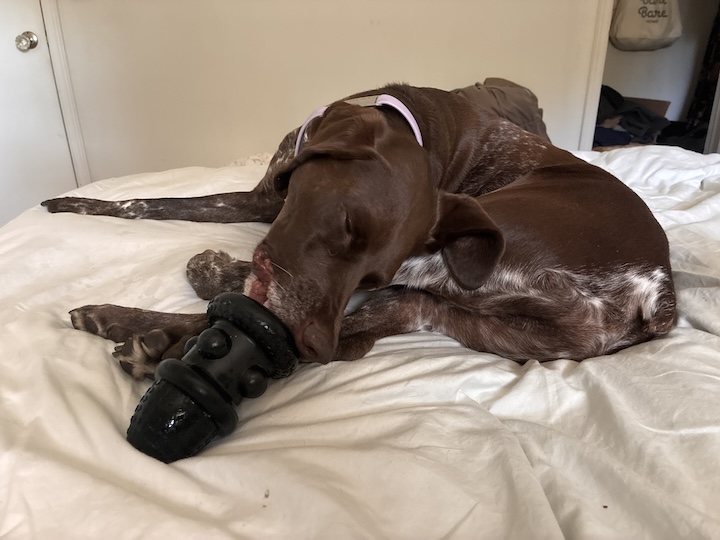
Sometimes passive play isn't enough for your dog breed
There are two types of stimulation that all dogs need, some more than others. A combination of physical and mental stimulation will make your dog happy and healthy both mentally and physically. Physical stimulation involves getting their bodies tired. They need exercise whether that’s going on walks, running, or playing in the yard. The other type of stimulation that dogs need is mental stimulation. This involves anything that makes them use their brain and think about a situation. This could include learning new tricks, practicing old tricks, using dog puzzles, and more.
Physical stimulation is important for all dogs, but especially intelligent breeds. The most intelligent dog breeds are also considered the most active. Some of these dog breeds include but are not limited to Border Collies, German Shorthaired Pointers, Vizslas, German Shephards, and Sheepdogs. In our case, Yuki (German Shorthaired Pointer) and Penny (Vizsla) at the ages of 5 and 6 years old, need at least two sessions of 1 hour uninterrupted exercise per day.
There is an obvious difference on rare days when we cannot exercise the dogs in the morning due to severe weather or unexpected plans. Skipping their daily exercise results in rambunctious, disruptive, and chaotic behavior. For this reason, exercising our two high energy dogs at least twice a day has become a requirement in our daily routine.
Off Leash Hiking
On weekends or longer summer days, off leash hiking is our main form of physical stimulation for our two hunting dogs. Successful off leash hiking takes plenty of patience, consistent training, and dog friendly hiking locations. Training collars are an essential tool we use for both training and an added extra safety insurance for recall. We use the Sportdog Training Collar (Amazon link) for Penny the Vizsla and the PatPet Training Collar (Amazon link) for Yukon the German Shorthaired Pointer. With consistent training and practice, these training collars allow peace of mind when hiking through the forest with your active furry friends. Be sure to follow any leash laws required as it varies town to town. We are lucky enough to have several off leash hiking areas nearby our home in New England.

Fetch
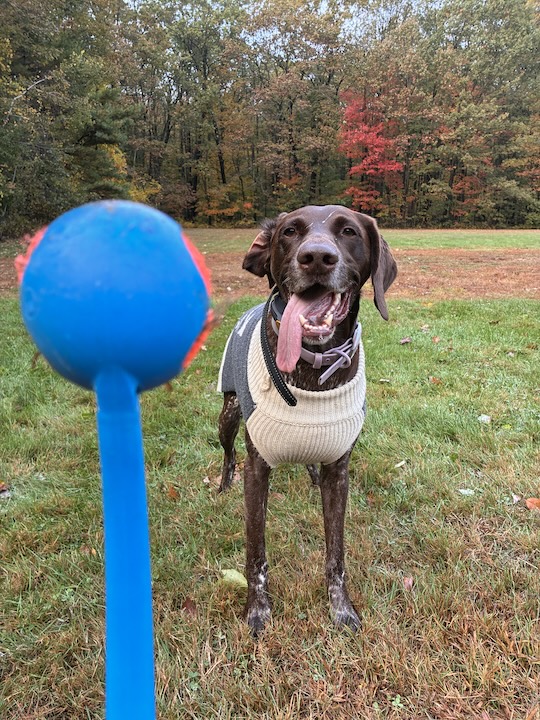
On days when there’s some light left after work, we often take Yuki and Penny to an open field nearby for some fetch. With Yuki, his ability to chase a ball and bring it back has always been instinctual. Yuki required almost no training to learn to fetch. He often plays long range fetch in an open field for an hour straight. He absolutely loves it.
Penny on the other hand, even though she is also a type of Pointer, only really has the instinct to chase the ball. At the age of 5, there is a 10% change that she will bring the ball back. Otherwise, she resorts to dropping the ball in the middle of the field (where Yuki promptly picks the ball up and carries it the rest of the way), or she stashes it in a nearby bush where we have to go find it ourselves. For this reason, our strategy is for one person to stand on each side of the field where we throw two balls back and forth, one for yuki, and one for penny.
Yuki’s favorite ball is his red Kong rubber ball (Amazon link) although we often use tennis balls or less favorable rubber balls at parks just in case one goes missing from Penny stashing it behind shrubs in the nearby forested area. We also use our Chuck-It stick throwers (Amazon link) which allows for longer and easier throws. Since we play fetch so often, the Chuck-it Stick is essential both for our joints and more importantly, not having to touch the slobbery dirty ball with our bare hands.
Leashed walking
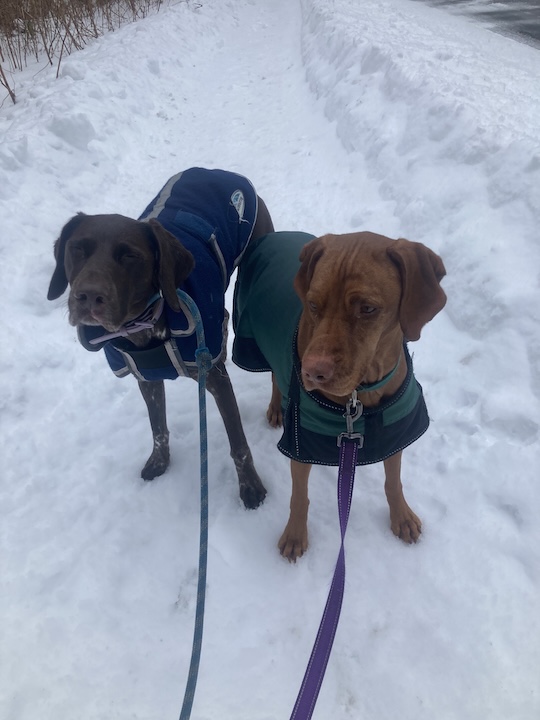
If we’re short on time (or daylight), a leashed neighborhood walk is always an option. For Yuki, we use a slip lead leash (Amazon link) which helps reduce pulling, although he doesn’t pull on a leash that often anymore. Penny uses a classic leather leash (Amazon link) or sometimes a martingale collar (Amazon link) since she’s quite energetic and tends to pull more often. A martingale collar and slip lead leash are both good options to help reduce pulling.
They don’t burn as much energy going on leash walks compared to off leash hikes, but it’s a good way for them to get their bodies moving, practice their leash skills, and sniff the neighborhood. Since a dog’s sense of smell is over 10,000 times more sensitive than a human’s, sniffing an area is almost like the equivalent of a human reading a newspaper. They know who passed by, if there was an animal in the area recently, and so much more that we’ll never know.
Off leash dog parks
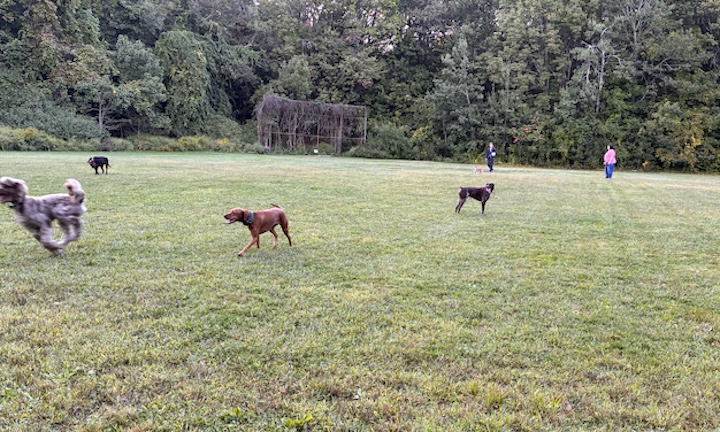
Off leash dog parks can be a great opportunity for your dog to meet other dogs, play, run, and sniff new areas. When we have extra time and daylight to burn, we love visiting our local dog park so Yuki and Penny can romp around with the other dogs. When going to the same dog park regularly, you’ll get to know the dogs that go there, how they prefer to be interacted with, and meet the owners to learn more about their dog. For safety, it’s always important to understand how to read a dog’s body language before going to a dog park. It’s also important to trust that your dog is socialized well enough and trained well enough to come back to you if you notice another dog’s actions are starting to turn unfriendly. Public dog parks are always a risk but with the right tools and taking the time to form a relationships with the regulars, dog parks can be a great addition to your dog’s exercise routine.
Playing with toys inside or in the yard
If we’re strapped for time at the end of the day or it’s already dark outside in the winter, we encourage Yuki and Penny to play with their toys, run around our small yard, or inside the house if it’s too cold. If there’s snow on the ground, both dogs love to chase snowballs in the yard. If there’s no snow, Penny runs after thrown sticks while Yuki chases his ball. Yuki’s favorite things to play with is definitely his collection of various balls, with his favorite being what we call “Red Ball” which is a small red rubber Kong ball (Amazon link). Penny on the other hand loves playing tug, or “keep away” with various stuffed toys. Her current favorite is a thick fabric starfish meant for tough chewers.
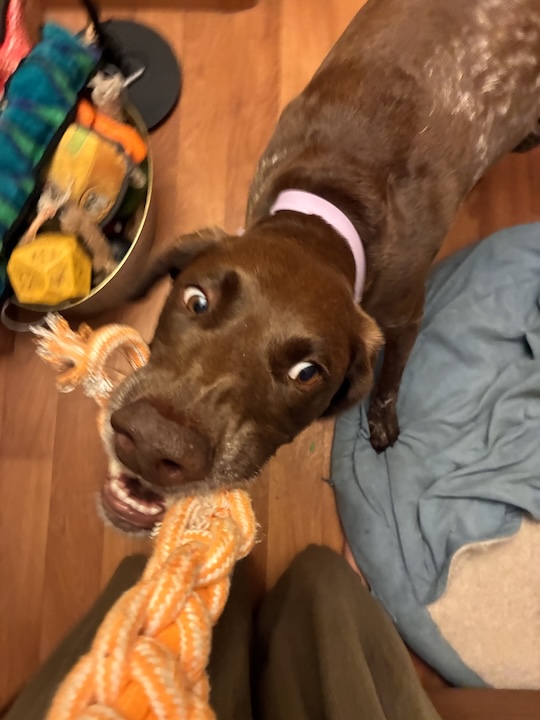
Like humans, dogs also become bored if there’s nothing for them to think about for prolonged periods of time. Tiring out their mind is equally important as tiring out their body. Without mental stimulation, a lot of dogs result in poor behaviors such as knocking over the trash, pacing aimlessly around the room, constant whining, chewing on household items, and more.
Learning new tricks
Intelligent dogs love to figure out a new challenge. This is especially true if your dog is eager to please or food motivated. Luckily for us, Yuki is a people pleaser and Penny is very food motivated so it usually takes less than an hour to teach them a new trick. Keeping the tricks fresh in their mind though takes a lot of practice and patience. Since Yuki’s internal goal is to make his humans happy, it’s no surprise that he is faster and more advanced when it comes to learning or practicing his tricks. He does them right away, always the correct trick, and with quite a bit of energy. Penny on the other hand, is only thinking of how she can get the food in my hand. If there’s no food, she’s quite stubborn about performing her tricks. Penny often does whatever trick comes to mind first and usually it's not the one you asked for. Regardless of why they do their tricks, it’s still a great way for your dog to start using their brain for a bit of mental stimulation. We’re at the point now where it’s difficult to think of a new trick to teach them, so we mostly rely on practicing what they already know.
Here’s a list of tricks and commands that Yuki and Penny both know:
• “Sit” - The classic sit, with hind legs bent on the ground, front two legs straight.
• “Paw” - They place either paw in our outstretched hand.
• “Other paw” - We always say this right after “Paw”. They place the opposite paw in our outstretched hand.
• “High five” - We reach out our hand for a high five and they place their paw on our palm.
• “Other high five” - We always say this right after “High five”. It’s the same thing as a high five but for the other paw.
• “Spin” - They Spin clockwise.
• “Spin, other way” - We always say this right after “Spin”. They spin counter-clockwise.
• “Down” - They lay down, usually starting from a sit position.
• “Dead dog” - This trick usually has a few steps beforehand. They do “sit”, “down”, and then “dead dog”, where they lay flat on their side. This one comes in handy for trimming Yuki’s nails!
• “Bow” - This one is basically the same position as a “play bow”.
• “Bump” - This is when they touch their nose to our closed fist. Some people call this trick “touch” instead.
• “Wait” - “Wait” is very similar to stay. We use “wait” if we’re to put a treat in front of them or their meal in front of them and we make them wait until we say the command “get it”. It’s also helpful on off leash walks. If Yuki is ahead and I call “Yuki wait”, he will stop walking and wait for me to catch up to him.
• “Stay” - A classic command all dogs should know! They stay still until you use their release word, for us it’s “free” or “go” or until we say “Come”.
• “Come” - A very important trick for recall if you’re hoping to have your dog behave off leash. We practice this almost daily. When we say “come”, they are required to come to us no matter what is going on around them. Having your dog perform this one well every time can take a lot of practice and patience!
• “Hello” - When we wave at our dogs and say hello, they stand on their hind legs quickly, sometimes jumping once in place when they are excited.
• “Dance” - Yuki and Penny know this one with slightly different hand motions. For Yuki, I put my arm down and fold my elbow at a right angle. When I say “dance”, he puts his two front feet on my forearm. For Penny, she was taught that when we put our two hands out in front of us with our palms up and say “dance”, she will put each of her paws in our two hands. Penny is slightly shorter, so this method works out a bit better for her height.
• “Up” - We use this command for the dogs to jump up on something whether it be in the car, on the couch to invite them up, or on the bed.
• “Out” - Whether we’re in a room that we don’t want the dogs in at the moment, on a hiking trail and they’re hopping excitedly in and out of a bush, or have their head in a bag or box that we want them out of, we use the command “out”.
• “Off” - Similar to “out”, we use this command when we want them either off our couch, bed, or off our laps (yes, even though they are large dogs, they still love curling up on our laps).
• “Closer” - This command is mostly just for fun and obedience practice. If they’re standing far away and we say “closer”, they take a handful of steps closer. This can be especially fun to practice with a treat on the ground. We put a treat on the ground, often on the other side of the room, make the dogs wait, and say “closer”. They know to go closer to the treat without actually eating it. Our release phrase for this is “ok, get it” and then they are allowed to eat their treat.
• “Back up” - This is just what it sounds like. We practice “back up” for a few reasons. One, for safety. For example, if they are around children or we don’t want them to get too close to an object that may cause harm, we say “back up”. Another reason to practice this trick is simply for obedience training and having them use their brains.
• “With me” - When our dogs are off leash, it’s important for them to stay by our side in some moments. The command “with me” means they have to walk next to us until we say their release words which are either “free” or “go”.
• “Turn around” - When we’re hiking off leash on an out and back trail, we use the phrase “turn around” to let them know that we are turning around to head back. We also use this if they are running down another off-shoot of a trail and we want them to turn around since we are not going that way.
• “This way” - This is another command for off leash hiking. If they are veering too far off the path or we are taking an off shoot of a trail and they don’t see us turn, we call “this way” and they will come running in the same direction that we are headed.
Tricks that only Yuki, the German Shorthaired Pointer, knows
• “Find it / where is it / show me (insert item)” - Since Yuki is much more of a people pleaser compared to Penny (a Vizsla), he’s learned a bit more tricks than Penny has. A few examples of what he knows how to find: a ball, his water bowl, shoes, a chair, air vents (he is slightly obsessed with the smell of them), and bugs. He will bring you right to each object and paw at them in front of you (except for the bugs which he will promptly eat once he finds them. We have to be careful what bugs we decide for him to find. He is a great ant exterminator.)
• “Rollover” - Another classic trick that yuki has learned is “roll over”. I usually start from a sit position, tell him down, and from there he rolls over. We just have to make sure there’s enough room so he doesn’t knock anything over! I usually do this trick outside in the grass so he doesn’t hurt himself. He tends to roll over with vigor.
• “Head down” - This one is very cute to show new people. When he’s laying down, I say “head down” and he places his head on the ground.
• “Talk” - This one is exactly how it sounds. We say “talk” and he proceeds to make a noise. Depending on his mood, it could be a whine, a large sigh/whine, a complaint, or a bark if he’s excited about a certain treat we’re holding. He’s very expressive!
• “On the right” - I taught him this when he was a puppy. We would often go for long hikes with him being on a long lead. When we were passing someone I would say “on my right” and he would move over to the right side of the trail. Now I use it more strictly for him to go directly to the right side of my body to walk next to me or sit next to me.
• “Go around/Other side” - Exactly as it sounds. Go around an obstacle, or to the other side of me or an obstacle.
Using buttons to communicate
Yuki and Penny are trained to use large color voice recording buttons (Amazon link) placed on the floor to communicate their wants and needs. We started with a couple buttons placed on the ground (Snack and Outside) and expanded from there, once they understood that an action was taken after they pressed the button. A few years after starting their button journey, these are the buttons that we have out currently for them to use:
• “Outside” - Used for when they have to go outside to pee or poop.
• “Yes” - Used when we ask them a question. Occasionally the two dogs will work together to achieve the same goal. For example one dog will press “Snack” and the other will go over and press “Yes”.
• “No” - Used when we ask them a question. Sometimes the dogs will argue with us by using this button. For example, if I tell them to stop barking or that they’re not getting another dinner, they’ll go over and press “No”. Yuki will also sometimes use this button if there’s a loud noise or if the kitchen becomes a bit smokey. He wants us to know that he does not appreciate what’s happening.
• “Help” - They use the “help” button when they need assistance from a human. Sometimes they use it when a toy is stuck under a piece of furniture that they want us to get for them. Sometimes they use this in conjunction with another button like “outside” or “where”. When we had a friend’s cat living with us temporarily, Yuki was afraid to pass the cat on the stairs or in tight hallway areas. He would press “help” and then lead us to where the cat was in his way.
• “Snack” - Sometimes we need to hide this button. They press this when they want a snack or if we are cooking something that they really like.
• “Hi” - When we get home from a slightly longer outing, sometimes they will press “hi” to greet us. They’ll also press “hi” when they want to be pet or want attention, or when someone comes over that they particularly like.
• “Ball” - They use this button when they want us to find a ball for them to play with. At the end of the day, we occasionally go to a park to play ball (fetch) with the dogs, so around that time, Penny will sometimes press “ball”, hoping that we will ask her if she wants to go play ball.
• “Where” - This is often used when they want to go somewhere or when they can’t find a toy that they want. Yuki has also started using this when one of us leaves the house, as if he’s asking the other human “where did they go?”.
• “Water” - When their water bowl is empty, they’ll press “water”. This is very helpful for us so we don’t have to keep as close of an eye on the water bowl. They’ll tell us when they need a refill.
• “Hungry” - They’ll use this whether it’s breakfast time, dinner time, or they are begging for more food.
Puzzle balls for meals
We have two different puzzle balls that we use for Yuki and Penny. On rainy, cold, or dark days when we don’t want to spend too much time outside, we often feed them their meals in a puzzle ball which they roll around the house, eating the food that falls out of the holes in the ball. To entice them further, we’ll add a few small treats in so it smells new and exciting. When they’re both done, they’ll often switch balls on their own to see if the other one left any food in their ball that they can steal. This often gives them yet another 10 minutes of activity, rolling around the other dog’s puzzle ball.
Freezing kongs with treats
Since I work from home, I’ll often freeze a Kong Toy (Amazon link) or another rubber toy with various treats inside and give it to them in the middle of the day. I’ll spread a thin layer of either peanut butter, homemade unsweetened coconut whipped cream, wet dog food, or any other dog friendly spread that will freeze well. I’ll also add in some treats that will freeze with whatever spread I used in the toy. This will keep them busy for about a half hour and help to tire them out midday. Sometimes I’ll also take a portion of their meal to freeze within the rubber Kong toys as well.
No matter what you decide to do with your dogs, making sure they get an appropriate amount of both mental and physical stimulation should be a daily goal.