
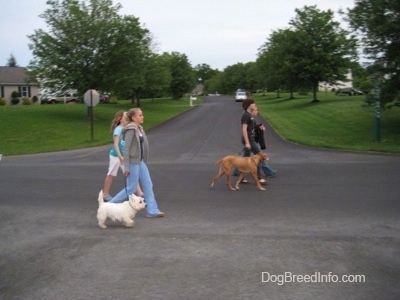
Walk your dog, do not let your dog walk you. If you allow your dog to walk in front of you while on a lead you are reinforcing in the dog's mind that the dog is alpha over you because the leader always goes first. This can lead to many behavioral issues that some regard as a "breed trait" or "personality," when actually it is your dog being in charge of its humans. When a dog walks in front, it does not drain its mental energy. The dog is not relaxed, as it has the big responsibility of leading the pack. This mental anguish can build up inside of a dog. When a dog is hyper or high-strung it means the dog is not getting the proper amount and/or type of exercise. If your dog runs laps around your yard or house, this is an indication that it is not getting enough exercise.
If you take your dog for long walks daily and it is still hyper, ask yourself, when we left for the walk who led the way out the door/gate? Who leads on the walk? Was the dog following you, watching you for direction or were you following the dog? Was the dog smelling where and when it pleased? If you answered "yes" to these questions you are walking your dog while it is in an excited state of mind. Your dog is worried about leading which does not calm the mind. If you answered "no" to these questions, then you may have a super high energy dog that needs even more exercise. It is not a natural state of mind for a canine animal to be so hyper.
Keep in mind it is not solely the act of heeling, but also that you as the human are making the decision for the dog to heel. How often do you walk? Do you MAKE your dog heel or does the dog heel when it pleases just because it gets tired? Just because a dog walks well on a lead, not pulling, and for most of the walk walks beside the human does not mean the human is being a pack leader; it really is about who is making the decisions. Was your dog calm and in a submissive state of mind when you snapped on their lead? When you left your home, who went out the doorway and/or gate first, you or the dog? Does the dog decide to heel when it wishes, but pull to the side to sniff or walk out in front when it pleases? Or is the human consciously making the dog heel? If the human allows the dog to decide, because after all he walks "pretty good," then the dog is making the calls and you are allowing your dog to be your leader. If it is all about who is making the decisions, can you decide to let your dog walk in front? No, since instinct tells a dog the leader leads the way, your decision to allow your dog to walk in front will be communicating to your dog that you are allowing him to be your leader.
A pack walk is also the best way to introduce new dogs to one another or to get dogs who already do not like one another to accept each other. Any unwanted reactions from one dog to another should be immediately corrected. By the end of your walk they will feel like they are one pack. It is important that the dogs who are out on the walk are all heeling beside the person holding the leash. Any dog that is walking out in front of their humans will begin to regard himself as the alpha of the group. By making the dogs heel beside or behind the person holding the lead, you are communicating to the dogs that the humans are above them in the pecking order and that all the dogs are on the same follower level. Remember, it only takes one alpha dog to set off any other dogs around. If you are walking multiple dogs that usually fight you may need more than one human to walk the dogs. Make sure all human walkers are making the dog they are walking heel and that they are correcting any signs of aggression towards the other dogs. You may allow the dogs to smell one another's back end, but make sure you keep walking in the process. The key is to keep moving forward. Keep the dogs walking and remain confident. The dogs will feel your authority or your weakness. Stay strong.
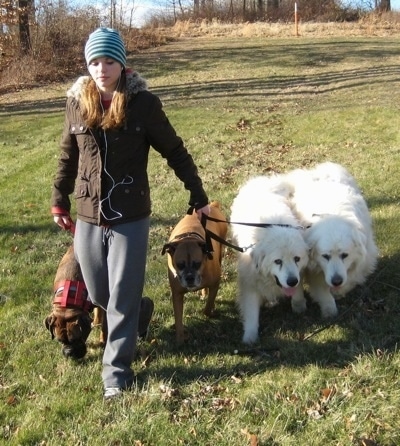
"The Boxer on the right used to get into awful bloody fights with the two white Great Pyrenees that were very difficult to break up. We began to correct the dogs using natural dog behavior techniques. The results were amazing. After 6 years of fighting it only took a day to communicate this was not acceptable and they never fought again. We still had to watch for signs and correct them at the right moments. However, as soon as we started walking the Boxer with the Great Pys all signs of the desire to fight between any of the dogs vanished. Here she is walking right next to them."
All dogs, regardless of size or breed, need to be taken on daily walks, jogs, runs, bike rides, rollerblading, or any other means you have to get your dog moving. Taking your dog for a walk is an important ritual in keeping your dog mentally stable. A dog, as an animal, is a walker/traveler by instinct. Packs of dogs get up in the morning and walk. Simply having a large backyard or taking your dog to the dog park is not going to satisfy this instinct in your dog. To your dog, your backyard is like a large fish bowl in which they are trapped. In nature fish swim, birds fly and dogs walk. Having a dog should not be about only fulfilling our human needs, we owe it to our dogs, to give them what THEY instinctually need.
While this might seem like a daunting daily task, the good news is walking is mentally good for humans, too.
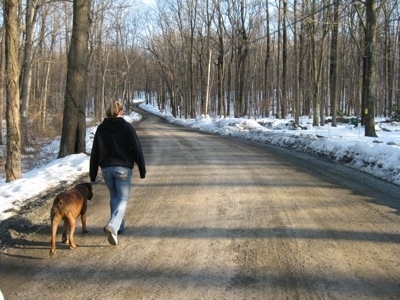
For a dog to be mentally stable, you as an owner must take your dog for daily walks to release mental and physical energy. The proper way to walk a dog is the dog walking either beside you, or behind you, and never in front of you. This may seem petty in a human's mind, however it means a lot in a dog’s mind. When a human allows a dog to walk in front, they are sending signals to the dog that he is leading the human. Instinct tells a dog that the leader goes first. A lack of exercise allows the buildup of the mental energy which would otherwise be released in a proper walk, and permitting a dog to be pack leader can cause many behavioral problems in a dog—such as, but not limited to, hyper-activity, neurotic and/or obsessive-compulsive behaviors—all of which are signs of a dog that is not mentally stable. An unstable dog is not a happy dog. Excitement in a dog is NOT a sign of happiness. Dogs that act very excitedly when their humans come home are showing signs of a lack of exercise and/or leadership. For a dog, excitement does not indicate happiness. In most cases it is a sign of a dog that is not mentally stable. When you come home after being gone, avoid speaking to your dog in an excited manner for a few minutes. Go and do something else first. When we see dogs as human, it is difficult to accept a dog's excitement as not being a sign of happiness, however, we must remember dogs are canines, not humans.
I have heard many people say that making a dog walk beside or behind them is mean. Those who believe this are seeing the dog as having human traits. It is actually crueler to assume your dog is just like you in his feelings and instincts and not see him as the canine animal that he is. Think outside the box and accept that your dog is an animal with different needs than a human.
Many people take their dogs out for a daily walk, however, the dog is walking in front of them. Getting a dog to walk properly on a lead is not as hard as it may seem—yes, even your dog(s). (You can walk more than one dog properly on a lead.)
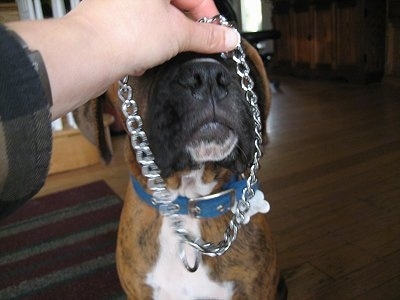
When getting ready to walk your dog, call the dog to you, do not go to the dog to put the lead on. After the dog comes to you make him sit calmly before snapping on the lead or slipping on the collar. Retractable leashes are not recommended, as they give the handler less control. The way you leave your house and property is also important. Your dog must go out the door after you. If you put the leash on the dog and/or leave the house while the dog is excited and leading you, then you are setting the mood for the rest of the walk to be in an excited state.
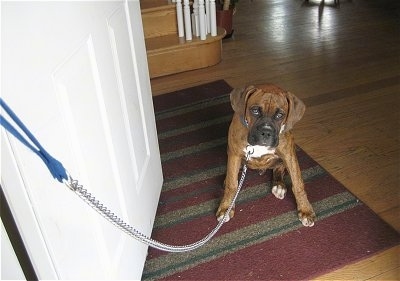
Take your dog to the front door and open the door. Make the dog sit quietly; do not allow the dog to bolt out the door. The dog needs to see you are the one who decides when it's time to leave.
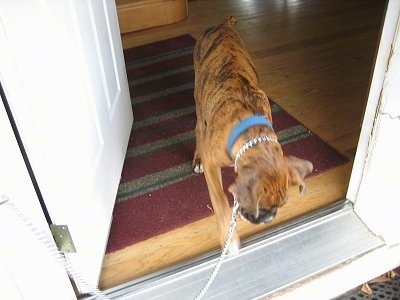
As soon as your dog is sitting quietly at the exit it's time to leave. Be sure you exit the house before the dog, even if it's just a step before the dog.
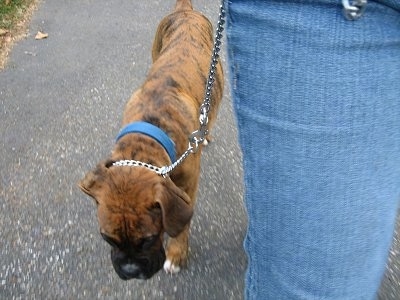
The collar should be far up on the neck, which gives you more control over the dog. A body harness is not recommended for walking dogs. Harnesses were designed for pulling—weight pulling, sled pulling, etc. Harnesses go around the strongest point on the dog’s body, making it difficult to control the dog. Keeping the lead high up on the neck, the same way they do in dog shows, will give you more control with less effort. A great tool for keeping the collar high up on the neck is the Illusion Collar. There should be no tension in the lead. Do not allow the dog to pull and don't constantly pull on your dog. Relax.
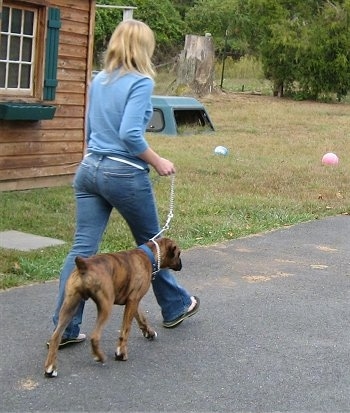
The lead should be short and hang loose. If the dog starts to pull, snap (tug) the lead up and to the side, throwing him off balance, then hold the lead loosely again (a very quick tug). If the dog starts getting too excited and you're not keeping him beside or behind you, stop and make the dog sit. Wait until he is calm, then start again. Do not call to the dog when you start walking again, just start walking. Pack leaders do not call the pack to come with them, the pack instinctually follows. The dog needs to learn he is following you, and tune into you, the person walking the dog. Do not praise your dog for walking calmly. This only creates excitement and you are more likely to pull your dog out of his calm, submissive state.
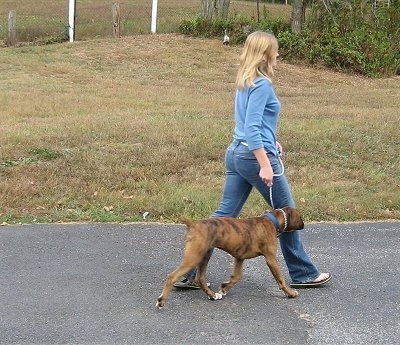
The dog should not sniff the ground and relieve himself where he pleases for the sake of marking; his job while walking is to concentrate on following his handler. When walking the dog you can allow it to tip you off of when it has to go to the bathroom and allow it to go if the spot is an acceptable place for a dog to relieve itself. The thing you need to watch for and use your judgement is whether or not the dog is relieving itself because it has to go to the bathroom or if it is simply trying to mark the area. It is ok if the dog tells you it has to go to the bathroom and to allow it to go, but it is not acceptable to allow a dog to mark its scent all over for the sake of marking on the walk.
If you pass a barking dog or other distraction, keep moving forward. If your dog averts its attention to the distraction, give a tug on the lead to avert attention back to the walk. If the tug does not work you can also use your foot, not to kick the dog, but to touch him enough to snap his attention back on you. If the dog is pulling, stop and make him sit. Correct any excited behavior from the distraction with a tug, and if that does not work you can also use a firm touch to the neck using your hand as a claw. Do this as soon as you see the dog starting to avert his gaze toward the distraction, or as soon as you see a look in your dog's eyes that tells you he is going to begin barking or growling. Timing is everything. This must be done right before the behavior happens or at the exact moment it starts. You do not want to wait until it escalates. If you wait too long before correcting a dog (we’re talking seconds), the dog may not even hear you; he will be too focused on the distraction. When correcting your dog, match your dog’s intensity.
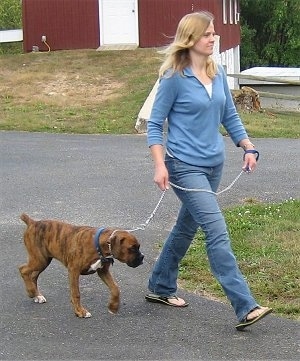
Walk at a good pace, keeping your shoulders back and your head held high. Dogs can sense tension or lack of confidence. Walk proud, like you are a strong leader. A dog will sense this and respond to it. Notice in the photo how there is no tension on the lead and the collar is up high on the neck.
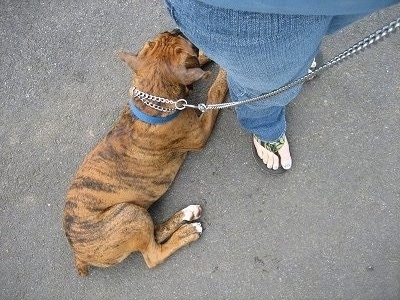
Some like to have their dog sit when they stop at crosswalks, etc. Sitting down is not necessary, however, the dog remaining calm is. The dog in this photo decides to lie down while his owner stops to talk.
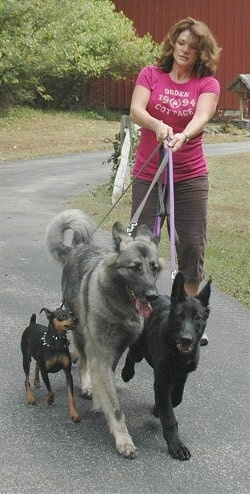
This photo shows the incorrect way to walk your dogs.
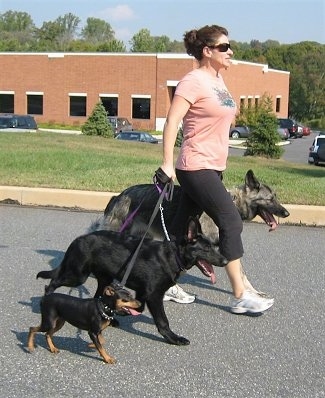
This photo shows the correct way to walk your dogs.
This picture was taken two weeks after working with the dogs on a daily basis. Read a true story about how the proper walk has helped this owner and her three dogs, A Dog Fight - Understanding your Pack
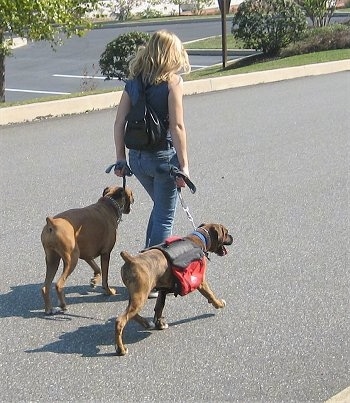
Putting a dog backpack on a dog is one way to make the walk more meaningful by giving the dog a job to do. Throw a couple of water bottles in the pack to add some weight. The dog will get a better workout, and it will also slow him down a bit, making it easier to walk. This is a good idea for some of the more active breeds with high energy levels.
If you are going off to work for the day, the dog should be walked before you leave the house. This will put the dog into a resting mode during the time you are gone. Dogs should also be walked before eating, fulfilling the dog's instinct to work for food.
Notice how very eager to please the dog is, though she has more built up energy than she knows what to do with. Hear the whine? She is obviously stressed and not relaxed. To put it into perspective, stand up and start acting like this dog. Do it for 15 minutes straight (don't forget to whine). Now picture yourself acting like this all of the time, day after day. This dog needs extensive daily exercise in order to drain her energy and be calm.
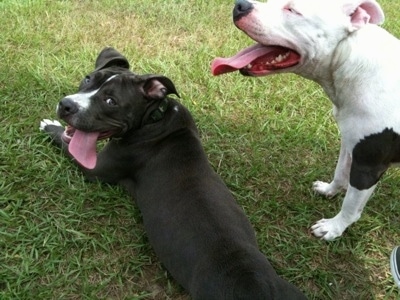
Troy, the 6-month-old Blue Nose Pit: "My fiancé and I would like to thank you for the information provided on your site. Our puppy was pretty well behaved, but after reading your site he is even better than we thought he could be. After only two walks he is now heeling perfectly—and we didn't even have to use a special collar. We had already been doing most of the things on the maintaining dominance list, but with the addition of making him go out of the door after us and waiting to eat his food, he is listening even better."
Sometimes bad weather prevents us from getting outside and walking our dogs. Even on these days dogs still need to release energy. Teaching your dog to walk on a treadmill is an excellent way to do this.
While getting outside and walking is best, a treadmill can work as a substitute when that is not possible. It also can be a very good bonding experience for both owner and dog as the dog exercises side-by-side with the owner.
Dogs, of all breeds and types, that are taken for daily walks, and that are made to walk beside or behind the owner, are less likely to be destructive, obsessive, have separation anxiety and/or dominancy issues, among many other behavior problems. Dogs with higher energy should be taken for longer, more vigorous walks, some two or more times a day. For a dog, walking is a primal instinct. Fulfilling this need in your dog will make for a happier dog and happier owners.
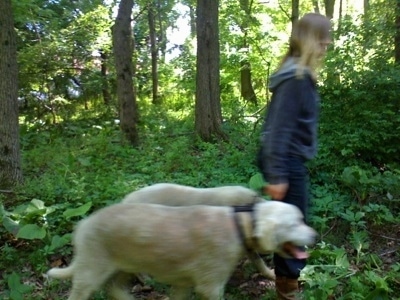
It only took one day to teach these two 120-pound Great Pyrenees how to walk properly on a lead. Both went from being unruly and pulling every which way, to calmly walking right next to the human. A couple of backwards boots in the butt (not a kick, but a bop) and a verbal, one-word "Hey" along with a sideways tug at the moment they were thinking about pulling, and the dogs got the message that the human was boss. Don’t forget the importance of the calm, firm confidence of the handler in making a huge difference in the success of the walk. The dogs can feel energy and would not have responded to nervous, hyper, scared or tense human emotions. The rest of the walk went smoothly with neither trying to pass. The dogs enjoyed knowing where they stood, and the human can now take them on more walks, because she is able to control both dogs by herself.
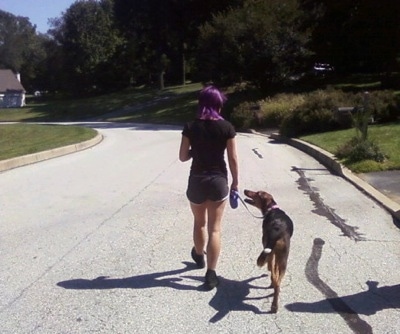
Some of us are fortunate enough to have a secluded, safe place to walk our dogs off-leash. I am often asked if a dog that walks off-leash is still seeing their human as pack leader. Yes, it is possible for a dog to run and explore the woods on a walk off-leash in a safe area and still see you as pack leader. To accomplish this, your dog needs to see that you are making the calls and deciding when it is OK to explore and when it is time to come back to you. A simple test, and something you should do before giving the command to explore, is to ask your dog to walk with you heeling without the leash. If your dog is willing to heel next to you when asked without a leash, you are doing something right. A truly happy, balanced follower will enjoy walking beside you when you ask, leash or no leash. If you are not able to do this keep working on it; our best friends are worth the effort.
While out on a walk I often see owners attempt to teach their dog not to react to my dogs by completely stopping and trapping their dogs in a corner. Some owners continuously put food in front of their dogs telling them to stay, others use corrections to tell their dogs to stay. What these owners are doing is teaching their dogs that passing another dog is a big event. What you should be doing is teaching your dog that passing another dog is no big deal and to keep on walking. Whether you like to use food as a distraction or if you simply wish to tell the dog to walk because that is part of life, be sure to keep moving. Stopping and making a big deal out of the other dog creates anticipation. It is teaching the dog that other dogs are indeed something to be concerned about. When you continue to walk you help the dog's mind move onto other things.
1. Question: Our dog obeys most commands but when we walk her (which we do morning and night) she has a split personality and goes crazy when we pass other people or dogs. She tries to pass us on the leash when she sees them. Any suggestions would be most appreciated.
Answer: The goal in walking is to have the dog heeling beside or behind you with a loose leash. The loose leash is the reward, the tension on the leash is the correction. Avoid pulling your dog as a correction as that instinctually makes the dog want to pull back. The correction is a snap, not a pull.
The trick to getting a dog to stop this behavior is convincing the dog you are stronger minded than she is, along with good timing. First, in your own mind, you have to picture your dog not spazzing towards the things she passes or she will feel it and will be more likely to do it. (Dogs can feel the emotions of others around them). Therefore, think about something that makes you feel confident. No anger, no anxiety, just confidence. Like a mother grizzly bear. With my own dogs I lower my voice so it almost sounds like a growl. When making corrections, do not use the dog's name, but rather a sound or another word like, "Hey!” or "Atttt" or "Leave it!".
As you are walking watch your dog for signs that she even THINKS about getting excited and give a snap to the leash, up and to the side, to throw the dog off balance. For larger dogs that get over-excited you can use the side of your foot to boot the dog in the butt behind you. This is not a kick but a redirect. Your timing must be right—not a second after she is already excited or it will be harder to control her. Watch the dog's eyes, watch for her ears to become alert, watch the tail to go up. Correct as soon as the thought crosses the dog's mind, and before the dog reacts. You have to match your dog's intensity without going too far over. If you go too far over it will not work, as if your intensity is too far under it will not work. Use your body to step in front of the dog if you have to block her because she is going for it.
Try and keep walking. Do not stop at the person or object. Keep walking. Seek out other things the dog barks at and practice. The more you pass things and correct the dog the less the dog will react if you are convincing that you mean it. In your head think of something you are passionate about. Not angry, but passionate, and use that energy towards your dog. It is a mind game. Who is stronger willed? Think of people who own horses. Somehow a 100-pound lady is able to lead a 1,000 pound horse. The horse's strength can easily drag the person, no matter how large the person is. It’s all in the mind—the ability to lead and have them listen. Who is the stronger being inside, not outside? You have to convince the dog that the stronger-minded being is you and you mean business.
I also recommend the Illusion Collar for medium to large sized breeds. This collar controls the dog high up on the neck, as in dog shows. This is the weakest point of the dog's body. The chest is the strongest so you want to have something that allows you to use less muscle power. Note: this collar is not recommended for dogs whose neck measures less than 13 inches at the base, or weighs less than 18 lbs. Dogs with any breathing problems, such as "pushed-in faces"; dogs with trachea or throat problems, such as Pomeranians; and dogs with elongated, overly slender necks, such as Greyhounds, should NOT use the collar. The collar was also not intended for dogs under the age of one.
2. Question: Does forcing your dog to walk beside you still establish that you are the leader if the dog is pulling but you are able to keep the dog next to you?
Answer: No, it's not the same thing to physically have to hold the dog next to you. The dog has to be willing to heel on its own because it is following you, not because you are strong enough to hold it back.
3. Question: What about sled dogs who are in front of the handler? What about guide dogs for the blind?
Answer: When you tie a dog to a sled and teach it to go on command, stop and turn on command as it pulls a sled its a job. It's putting the dog to work. Just like tracking dogs. If you show it a scent and ask it to find it, track it and you follow the dog it's a job. You are asking the dog to work. Dogs are not stupid, they know the difference between you asking them to work and them leading you on a walk. When you are just out walking the dog on a leash and you let the dog in front you are communicating to the dog that you are letting them be your leader. When you do that you cannot expect the dog to listen to you at all times in other areas.
Contrary to what many people assume, guide dogs are not in front of their handler. They are at their side on a short harness. The dog is guiding the handler as a job and is also following the commands of the handler all day long. The dog has clear, consistent rules. It must ignore other animals, people and things, which is a huge mental challenge. If everyone trained and worked their dogs to behave like a guide dog there would be very few misbehaved dogs in the world.
4. Question: Does taking a dog for walks in your neighborhood increase the likelihood that it will want to roam on its own? Their is a debate in our family. One person says that if you take your dog around the neighborhood, it will learn about the other animals and smells, and be more likely to leave home in search of those things. Or do the benefits of walking outweigh that chance?
Answer: Your dog already knows there are things outside its den (your home). It can hear, smell and sense things beyond your property. The argument can go both ways, if you never show it what is out there it may decide to go see it for itself. The bottom line is that dogs have an instinct to migrate (go for walks) and it is cruel to bring an animal into your home and not give it what it instinctually needs as that animal. In a dog's case, a walk. Dogs who do not get walked are more likely to run off because they have pent up energy and racing anxious minds.