The Beast(s) of Gévaudan
This is an updated excerpt from a manuscript I wrote more than 20 years ago on future wolf management options in Western Europe. As for the main subject, most of this work is of course completely outdated now, mainly thanks to the wolf's own cooperation. It has expanded from what populations were left in the 1980s at a rate we should not have dared foresee then. Until now I have published only one other part of it, a calculus model of spatial management of wolves and their ungulate prey.
Having contributed some photos taking in the Parc Sainte Lucie in the Gévaudan area to the Dog Breeds Info website prompted me to adapt and update what I wrote then about the "Bête du Gévaudan". Although "updating" about an affair which dates over 200 years back is quite a relative thing of course…
Studying "Beast" cases helps one get some insight into human mentalities and more specifically public fear movements. As human mentality is quite often the limiting factor in predator management and indeed in all management of our natural heirloom, I consider reading world literature and not only professional books and papers vital for a biologist engaged in this matter.
After all, why else is an author publicly recognised than because he or she has the verbal aptitude to express thoughts we all have but are not all equally adept at formulating? From Sir Walter Scott through Marguerite Yourcenar to Andre Brink, I have found pertinent passages on the perception of the natural environment in general and on wolves and other predators in particular. "Beasts" are an extrapolation of man's way of thinking about animals and thence reflect them more strongly.
I will not give an exhaustive literature list about the subject. The three works that I know of which I consider to be of major importance will be listed at the end of this article. Whosoever seeks further reading about the subject will find it there.
Introduction
The "Bête du Gévaudan" became a legend in its own time and is still very prominent in French wolf-lore. As is often the case with legendary subjects, interpretations ignoring the documented facts are the rule rather than the exception. It has been written about by historians, journalists and amateurs rather than by biologists for the most part. Its importance as a historical case lies in the fact that is has been well documented.
The Gévaudan region is in the French Department Lozère, in the Eastern part of the Massif Central. In june 1764 through june 1767, a Beast or Beasts (opinions differ widely, but I shall, for convenience's sake, refer to it or them as the Beast) killed roughly 100 people. But for one adult man, all of these were women and children. After a first Beast was killed, the killings stopped for a while, but started again until a second one was killed in June 1776.
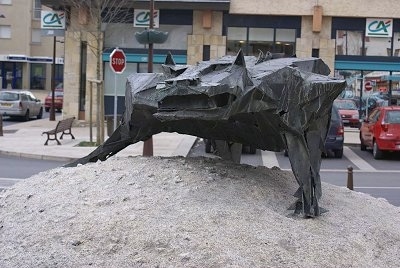
Statue of the Beast on a small square in Marvejols, France
The Beast
Much has been written, with or without common sense, about the identity of the Beast. I shall not go into detail, but outline a few major points.
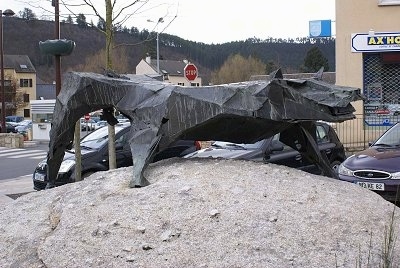
Statue of the Beast on a small square in Marvejols, France
Not Rabid
The Beast survived beyond a few days from the start of its career, it did not indiscriminately attack man and beast alike and wounded escapees did not contract rabies. The Beast may thus be concluded not to have been rabid, as Clarke and Castres conclude.
Not a Wolf
Louis Michel, when writing his book about the Beast, took the fact that wolves were innocent in this affair as a starting point to be proven. He is the director of a zoo and a wolf lover and this is understandable and OK with me. As for myself however, I consider that I'd have been a very poor biologist indeed if I had taken such a position from the start. It just grew with studying the case and remains what it is : a hypothesis which is liable to be toppled over at any moment by anyone who finds the arguments to do so.
Behaviour
In keeping with what has been related about the 18th Century French peasant's knowledge of the wolf in Chapter II, the Beast, when it started rising to its dubious fame, was said to be almost anything but a wolf. The first reports made by young shepherds mentioned a "big dog" menacing them, which was fended off by cows and oxen defending them. The animal's boldness and ferocity did not correspond to what these people were familiar with, so it was generally concluded that it simply could not be a wolf. Taking today's confusion between different canids into account, one would tend to say that the point remains moot. However, it should not be forgotten that people were very familiar indeed with wolves and their usual behaviour when confronted. They saw them almost every day and many a shepherd saved one or more of his sheep from their jaws by scaring a wolf off or knocking it over the head with a stick. This is not merely history, such cases have been reported from Central Europe until present days.
Morphology
Both animals considered to have been "The Beast" have been measured, weighed and described in detail in the archives. The second animal's carcass was sent to the royal court (to be quickly dispatched with because of the odour acquired with the duration of the transport…) and the surviving pictures clearly represent a canid. Clarke, however, remarked that one of them was mentioned to have a white spot on its chest, a feature often seen with dogs but never with grey wolves.
I have taken the measurements for what they are worth and calculated the ratio of shoulder height to weight from them. This ratio may vary strongly with seasonal weight changes in wild wolves. However, the wolves on which I had the data to calculate this ratio were all clearly lighter relative to their shoulder height than dogs, including one Portuguese female which had been weighed twice and whose weight differed as much as about one third between the two times. Actually, among the dogs I measured and weighed those which came nearest the wolf in this ratio were certain Border colleys, a breed selected on speed and mobility for their work. I don't have any data on greyhounds and whippets, who would probably form a class of their own as for such a ratio…
The two beasts' ratio falls into the range of big dogs and not into that of wolves.
I must mention that among the dogs I measured and weighed those which came nearest the wolf in this ratio were certain Border colleys, a breed selected on speed and mobility for their work. I don't have any data on greyhounds and whippets, who would probably form a class of their own as for such a ratio.
How many animals involved?
Castres (1985) deals with the identity and number of the Beast(s). He plotted the documented attacks on a map and thus showed that one can distinguish two overlapping ellipsoïd areas, which appear to correspond to two animals' home ranges. Both correspond to an area within which one of the two animals guilty of at least a major part of the homicides was killed.
Mechanisms
Knowing that attacks by wolves on humans were so rare that until recently it was generally believed that none ever took place, how could we explain that an unidentified canid (for as I will argue, it was most likely a canid) started wantonly killing them by the score?
Fear-triggered attacks
Castres points out that the panic sewn by the Beast may have led to such extravagant manifestations of fear by people encountering wolves that the latter were triggered into attacking. Some dogs are known to have a predilection for being aggressive towards people openly afraid of them (others, such as mine, are overtly disconcerted about something as unusual as people being afraid of them…). In other words : humans might have provoked attacks from wolves which would otherwise have dodged them.
This makes me think of an observation quoted by Barry Lopez in "Of men and wolves" : wolves approach 4 bison, of which 3 are in good shape, but one is lame. The healthy animals ignore the wolves, but the lame one gets up and confronts the wolves and is attacked. Most of us will have seen numerous sequences recalling this scenario, featuring lions selecting the weakest buffalo or gnu in the herd before attacking. Manifestations of fear or nervousness may trigger an attack which would otherwise not have taken place. Cases of dogs being triggered into attacking children running away from them or otherwise behaving in a way they assimilate to that of a prey abound. Knowing the species' deep-rooted fear of man, this would not seem very likely to happen with wild wolves. It may well have occurred with dogs, however.
Predators have their energy budget to manage and will not usually waste time attacking prey in perfect physical shape. This would also be sheer lunacy because of the risk of getting hurt. Forget about the myth of the "noble predator" seeking the welfare of its prey species by culling the weakest, it's just a matter of common sense.
Scavengers First
Many authors have pointed out that scavenging on human bodies may have accustomed wolves to eating human flesh, Clarke among them. This mechanism is so well known to play an important role in wolves' getting used to eating livestock that in the 1980s livestock breeders in certain states of the USA who left carcasses lying around in the field were not reimbursed for wolf depredation.
So-called "sieges by wolves" of human settlements in times of famine correspond to situations in which human carrion must have been abundant, people weak and other food scarce. This scarcity of other food rendered garbage heaps even more important food resources than they already were and still are for many European wolves, who therefore gathered around towns, villages and hamlets.
Humans were perhaps not as abundant, but often as defenceless as their sheep in Europe through the middle ages and into the 19th century. It would not seem more than logical that wolves should have exploited this food resource. Other predators certainly do and the myth of no wolves ever attacking or eating humans has sufficiently dealt with in the only literature source I shall list that is not directly about the Beast : Mech and Boitani.
Predatory Behaviour
Anthropophagous "Beasts" have repeatedly shown quite normal predatory behaviour, apart from the unconventional choice of prey species. Indeed, they attack mostly the weaker and isolated individuals. On a total of slightly over a hundred recorded victims, the Beast of Gévaudan killed only one adult man, all the other ones being women and children. A "beast" around Kessel, in the province of Limburg in The Netherlands, killed exclusively children (11 in total) in 1810 and 1811. Both "our" beast and the latter one detached the heads from certain victims.
The Beast of the Gévaudan would seem to have had a predilection for the neck, the shoulders and the breast. Yet it was also reported to come back to its victims when it could and one body was eaten so entirely that the priest refused to draw up the sepulture certificate. This resembles to normal predatory behaviour. The Kessel beast's peculiarity was that it did not eat its victims' bowels, usually a prized delicacy among predators. In both cases, being chased away from their victims and the latter being taken away would logically incite them to kill more individuals. In a natural situation, part of a carcass is always lost to scavengers such as the fox and the vulture, but more of it can be used by the initial predator.
The Circumstances
Castres, after describing the scarcity of the human population of the Gévaudan region, relates (translation Johan Timmer) :
"The preceding years have been particularly harsh, there have been the inevitable famines, as people have always known them, although they are less severe than they have sometimes been ; people die of starvation and cold, but these are mostly poor wretches, tramps. On the other hand, the cattle have suffered dearly from diseases. Animals have died by the thousands, a school has even been founded to train veterinarians to fight them." (the first veterinarian academy in France, in Lyon; JT).
"But this hasn't kept the herds from diminishing severely. The sheep have been replaced by one or two cows; the village's animals are hardly pastured together anymore (most likely for fear of contamination; JT), the little shepherds disperse into the mountains, each ones busies himself with his beasts".
Vulnerability of flocks
The livestock left are thus more susceptible to attacks and so are their shepherds. A study of the relationships between husbandry methods and sheep losses to canine predators in Kansas showed that herds of less than 50 head were found to have a rate of loss nearly twice as high as those of 300 and over. Moreover, cows are more difficult prey for wolves than sheep.
Livestock being scarce, peasants possibly hunted (poached) on a larger scale, so that the game population may have been at a low as well.
Ecological stress
Human and livestock carrion has abounded for some time, especially in winter, as had the all-but-dead poor, and otherwise food was scarce for all.
In other words, the situation is one of ecological stress, and the factors which may lead a predator to venture into this unusual feeding niche, drawing upon humans as a food resource, are there.
The affair of the Beast officially starts in june 1764. Attacks had been reported earlier, but poor communication had kept these from being connected with one another. It has, therefore, probably really started in spring, when the winter stock of tramps dead or dying of cold or hunger or both is depleted. These tramps would hardly have been reported as attack cases and registered in the parish records if their disappearance were noticed at all. With the end of the cold season a predator specialized in this type of quarry would have had to look elsewhere for food.
Tender youth, tough luck
Livestock, mostly in their stables in winter, started roaming the mountainside again. With them their shepherds, mostly children. Castres quotes Antoine de Beauterne (one of a sequence of officials dispatched to the area by the King to organize the chase of the Beast) as saying that people were still severely undernourished, to the point where peasants recruited for the battues fainted repeatedly. What to think of the infant shepherds the Beast encountered?
They were the most logical prey for a predator which for one reason or another had got the taste of human flesh. Both animals killed as "the beast" were adults apparently in full health, so this habit must have come about some way, my hypothesis being one of the possibilities. Only one adult man was among the 100-odd victims, all the others were children and women, nearly always attacked when they were alone.
Conclusion
Quite clearly two animals were involved. When the first was killed a lull in the killing of humans occurred, but it picked up again later the same year to stop only when the second "beast" succumbed.
Considering the facts and factors given above, I think the two animals killed were canids. Yet several considerations lead me to suggest that they were most likely not wolves. Of the descriptions given of them during the three-year period, the earliest ones, given by shepherds before panic set in and "The Beast" was invoked are probably the most interesting and reliable ones. From the moment such incidents grow into a "beast" affair imagination starts working and the human mind feels the need to distinguish "the beast" from the usual fauna. Some later descriptions of the Beast were pretty ludicrous indeed. To remain with affairs concerning canids in areas where wolves are or were present, certain "facts" are recurrent : not a wolf or if a wolf, a black or otherwise unusual one which has come from elsewhere.
Clarke suggests the possibility of two siblings from a first generation litter of wolf-dog crossbreeds. The two home ranges distinguished by Castres appear coherent with this idea. Hybrid vigour might explain why these crossbreeds were the ones bold enough to start preying on humans. Much has been written to warn the public against human-raised wolf-dog crossbreeds as pets and many lethal or otherwise serious accidents have happened with them. Yet this does not say anything about how such animals may behave in the wild. I asked Luigi Boitani about this, who said that though information on the occurrence of wolf-dog hybrids is accumulating, he has not heard of anything to confirm particular vigour in them.
Wolves tend more to feed on dogs than to breed with them. This is no new knowledge : certain 18th century authors praised the wolf as an excellent gamekeeper who curtailed stray dogs and discouraged poachers by emptying their traps before they themselves could get back to them. Russian observations from the middle of the 20th century have confirmed this and since the wolf started expanding again over the last two or three decades their predation on dogs and cats has become commonplace.
Theories about evil-willed people having trained dogs to set them on people abound to explain the Beast, the most recent one among them being Michel Louis'. Others have tackled the matter using "the scientific method according to Aristotle" or other trains of thought along lines such as that it was too big to have been a squirrel and ending up concluding it must have been a crossbreed of a bear and a tiger cat or whatever else would appear "likely".
We'll never know what the Beast of the Gévaudan really was and I wouldn't have spent as much time reading about the affair if there wasn't that much to learn from it about how the human mind whips up fancies and warps the facts. Once one has started reading, one can't help shaping one's own ideas and that's the only thing I've presented here, with no pretension at all.
References
- Castres, Georges-André
La Bête du Gévaudan
Thèse pour le doctoral vétérinaire (Diplôme d'État)
Université Paul Sabatier de Toulouse
- Clarke, C. H. D., 1971
The Beast of Gévaudan
Natural History, april 1971
An abstract is now available on :
http://wolfology1.tripod.com/id106.htm
- Louis, Michel, 2000
La Bête du Gévaudan
L'innocence des loups
Nouvelle édition mise à jour ; collection Vérités et Légendes, éditions Perrin
ISBN 2-262-01739-5
- Mech, L. David and Luigi Boitani (editors), 2003
Wolves
Behaviour, ecology and conservation
The University of Chicago Press
ISBN 0-226-51696-2
We'll never know the truth about the Beast if the Gévaudan, but of all I've read, Clarke's and Castres' papers are the best efforts to get anywhere near it.
Michel's book will probably prove the easiest to find (for those who read French) and contains much of the information available. Yet his avowed aim is to claim the wolf's innocence in the affair. This is part of his book's title and he starts it with a quotation from Konrad Lorenz to the effect that recent studies have shown that no wolf, however famished, has ever spontaneously attacked a human being. Clarke maintains this as well, quoting the editor of a Canadian periodical who offered a prize for anyone who could furnish a truly documented case of such an attack, which nobody ever claimed.
Mech and Boitani edited a book which is the synthesis of 20th century knowledge about the wolf and a major reference in this field. In Chapter 12 of this book the non-existence of attacks by wolves on humans is demystified the occurrence of such attacks is linked with the previous availability of human carrion.
I've always wondered why wolves should not have eaten us. After all, we don't run as fast as sheep or deer or almost any other potential prey and have no claws, fangs, hooves, horns or other means of defence. Until we learned to use fire or acquired firearms we were pretty easy prey actually. The wolf's fear of us, which has mostly kept him from attacking and eating us, is probably something quite recent on an evolutionary timescale, born from the centuries of merciless persecution since we had the means for that. Most other big predators eat humans now and then, so why shouldn't the wolf?
Johan Timmer, 2007© Dog Breed Info Center® All Rights Reserved