
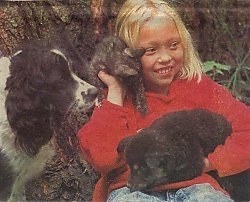
Most of a dog’s behavior habits are formed from birth to one year of age. When you bring your new puppy home, it is important to get it accustomed to different sights and sounds. Slowly introduce it to the things in your household. If your puppy growls at an object or person, do not pick him up and cuddle him. This reaction will be rewarding to your puppy, and will intensify the dog's behavior. It will teach him that the appropriate reaction to fear is to growl. Growling can lead to biting. Rather, the dog should be corrected, much like a mother dog would to their own puppy. Be stern, firm, confident, and consistent.
Tell him "no," show him the object and let him know there is nothing to be afraid of. You may need to give him a touch that matches your dog's own intensity (mimicking a mother dog). Puppies like to play. They chew on everything and will even try to chew on your fingers and legs, sometimes with a playful growl. Do not confuse this behavior with the defensive growl of fear.
Take your puppy out often. Show him all kinds of sights, sounds, people and animals. Once your dog has had all of his shots, you can bring him to a dog park. Dogs should be taken for a pack walk before getting to the dog park, in order for them to be in a more sociable state of mind. Be careful when introducing your puppy to other dogs and animals. Know your dog's breed traits and use your best judgment. For instance, if you know your neighbor’s dog is dog-aggressive, take your puppy to the park instead to do your doggie socializing. If you know your puppy’s breed is a hunter, take extra precaution when small animals are present. Always correct your puppy if he shows any signs of aggression or domination toward another animal or person. Do not laugh it off as being cute.
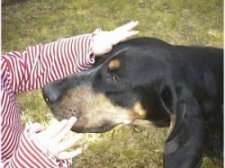
If there is a baby in the house, at the first encounter, carefully let your puppy smell the baby from a distance, then ask the dog for space, meaning, ask the dog to back away and stay away, as the baby claims HIS or HER area. This will make your baby higher in the pack order than the dog and be the start of the bond between your new dog and your child. Teach your children to respect the puppy, and teach your puppy to respect your children. NEVER tolerate growling, even with small dogs. Growling never leads to anything good. It can be a sign that your dog thinks he is, or is trying to be Top Dog.
Three weeks to three months is a critical age in socializing your puppy. This is when most of his behaviors are being formed. For this reason it is important to find a breeder who takes time to socialize their puppies. When you get your puppy or adult dog home, continue their socialization. If the breeder did not do a good job socializing the pup or if your adult dog is not well socialized, with some work on your part, you can change its behavior. Introduce it to all types of sights and sounds, correcting it at the right moment if it should begin to act out in an inappropriate manner. For a dog, life is all about the moment, and you can, at any time change the way it views its surroundings. In order for you to do this, you yourself will need to be in a firm and confident mind-frame. Dogs can read human emotions and if you are anything but, you can set your dog off. No words need to be spoken for this to happen, they can feel what you feel; you cannot hide it. They need you to be strong-minded, as dogs instinctually need a strong pack leader to be mentally stable. A dog will feed off of the way a human feels. If you are unstable, anxious, worried, nervous, scared, hyper, etc., your dog will feel this. Their reactions to a human’s instability will vary. It may empower them and they may try to take over, to "help" both of you survive. Or it may make them mentally unstable, becoming fearful, or nervous. Fearful dogs sometimes act out with aggression. Dogs NEED a strong-minded leader. They do not listen to instability.
So while you take your dog out and introduce him to all types of new sights and sounds, pay honest attention to the way you feel as well, because your dog already knows.

Written by Sharon Rose© Dog Breed Info Center® All Rights Reserved