Small Dog Syndrome
(Little Dog Syndrome)
Small Dogs vs. Medium and Large Dogs: Dog believes he is the humans’ pack leader

Small Dogs vs. Medium and Large Dogs: Dog believes he is the humans’ pack leader
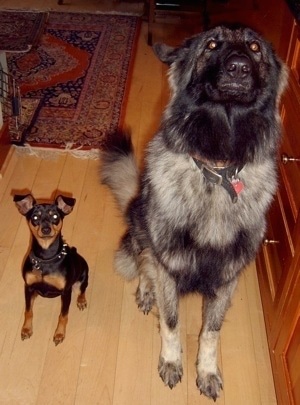
Are you one of those people who prefer larger dogs? Do you know someone who has told you that they prefer larger dogs because small dogs are yappy and snappy? Whether you are a large-dog person or a small-dog person, one thing we all would agree on is that a larger percentage of small dogs tend to have a different type of temperament than medium and large dogs. Small dogs have earned the reputation of being yappy, snappy, jealous, protective, wary of strangers and not the greatest child companions and, unfortunately, it has become widely accepted. Similar to the myth that Pit Bulls are all vicious fighting dogs whose jaws lock and will not let go until their prey is dead, that's just the way some small dogs are, right?
I received a package and my two Boxers went over to greet the UPS driver. I called the dogs back and the driver explained he didn't mind saying hello to my dogs. He said he could tell they were friendly and added, "It's those small dogs you have to watch out for."
So why do little dogs tend to act differently than large dogs? They are all the same type of animal, a mammal of the Canidae family, of the order Carnivora: Canis lupus familiaris, which is a domesticated subspecies of the wolf. Commonly referred to as a canine, this type of animal has instincts that need to be fulfilled in order to be happy and balanced. Let's take a closer look at how we treat large and medium dogs, as opposed to how we treat small and toy dogs.
Many behaviors we humans do not allow large dogs to get away with we find “cute” in small dogs. For example:
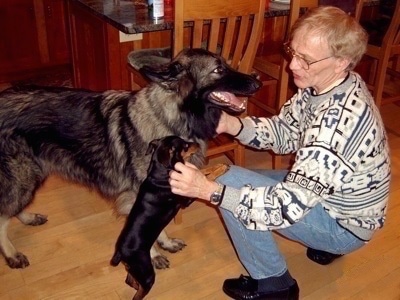
If an 80-pound German Shepherd jumps up on a human, everyone would agree that this behavior needs to be corrected. Everyone sees this as a problem and the owners would seek help from a trainer, and/or read up on the Internet to remedy the behavior. At the very least, the dog would be locked in a separate room when guests arrived to protect the guests from getting hurt.
Now picture a little 8-pound Miniature Pinscher jumping on a human. You look down and I’ll be darned, it's kind of cute. It does not hurt and people think, "The dog likes me!"
But what does it really mean? If dogs were human this would be true... but they are not. Jumping has a totally different meaning to a dog than it does a human. It's a dominancy and respect issue. For a dog, space is a sign of respect and when you allow your little dog to jump on a human you are allowing him to disrespect a human; you are allowing him to display pack leader behaviors.
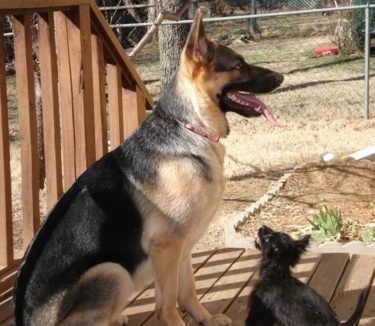
Sadie the 70-pound GSD, with Rudy, a 4-pound Chorkie.
If a German Shepherd were to growl at your guest, you and your guest would both know there is a problem. Something has to be done. However, if that tiny 6-pound Chihuahua growls, well, it's just what he does. He's a Chihuahua, right? Wrong. There is no difference, in a dog’s mind, for a German Shepherd to be growling at a human than there is for a Chihuahua. It's just another behavior we humans let those tiny dogs get away with.
If your 5-pound Yorkshire Terrier decides to bark and growl at another dog while you are walking down the street, or as another dog passes by your house, it's almost seen as cute, because you see it as your tiny dog thinking it is a big dog. However, if your 120-pound Akita barks and growls at another dog, the Akita is more likely to be put in its place and told to stop. The fact is, no dogs should ever be allowed to display dominant behaviors. Whether it be a huge or tiny dog, their pack leaders (humans) should tell the dogs "NO" and follow through until the dog understands this is not an acceptable behavior. And for the record, dogs do not "think" they are either big or little. They live in the moment and are just what they are, reacting to the moment. To dogs, size means nothing.
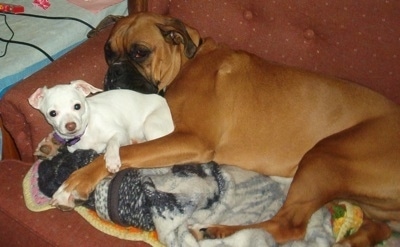
Roxanna the Boxer laying down with Miya the Jack Chi hybrid.
If you were eating dinner or working at your computer and your 70-pound Boxer came running over and jumped up on your lap, chances are you would knock it back down telling it, "No, not now, I am busy." However, if that 5-pound Maltese jumps up on your lap, well it's just cute. He loves you and just wants to be on you. There's that space issue again. Pack leaders decide when and where to do things. The pack leader belongs on top. It is OK for your little lap dog to sit on your lap. However, it has to be at times when YOU invite him.
If you are sitting down watching TV on the couch, your little dog can jump up next to you on the couch, so long as your dog understands it is your couch, not his. You need to make your dog wait until you invite him to climb into your lap. When a dog makes it a habit of jumping up on a human at his own free will, we humans see it as love and affection. However, to a dog, it is a claim; the dog is trying to own you. So the next time you notice your dog is adamant about being on you, remember, he is claiming you, not loving you. The human needs to claim back their space and the dog must be told he can only climb on top when the human invites him.
If you feel your dog is jumping on you in an "I own you" way, it is best not to put or knock the dog on the floor. Rather, use your fingers to “bite” her off (poking with enough intensity to make the dog react by moving). You need to communicate with your body language until she moves off of the person by herself. Make her move off; do not physically move the dog. When you see the dog settling down into a calm submissive state (head down low, not making eye contact, ears back, tail relaxed and not tucked in, not rigidly high, the dog may lay down), then it is OK to invite her on you, if that is what YOU want. However, if the dog once again gets in an "I own you" stance, she needs to be moved off again by making the dog move, not by you moving the dog. The dog needs to be the one physically moving off.
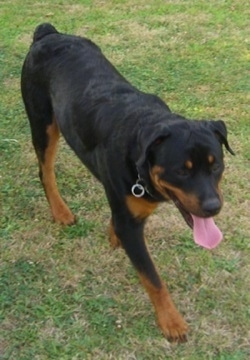
Jeremy the Rottweiler
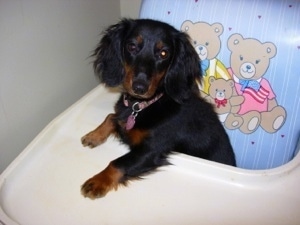
Francis the long-haired Miniature Dachshund
If your 120-pound Rottweiler decided to viciously bark at your housekeeper...you would KNOW you have a problem. However, if your tiny little Dachshund does it, you would inform the housekeeper to avoid the dog. The little dog may hide under the table barking and growling and be told to be quiet, but the correction is never really followed through on. The houseguest is told to not put their hands under the table. However, if this were a Rottie, the behavior would be addressed. Small dogs are more likely to be allowed to display dominant behaviors that should never be accepted.
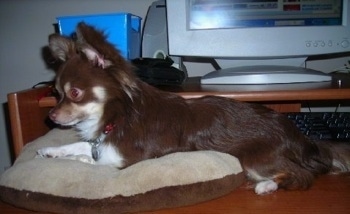
Prince the long-haired Chihuahua
Ever see a small dog jump up on its owner's lap and growl at anyone who comes too close? The owner feels the dog is "protecting" them "because he loves me," when actually the dog is "claiming" ITS property. Talk about allowing a dog to be alpha. Now imagine a Doberman Pinscher on that same person's lap, snarling if someone comes too close. Picture in your mind, going back and forth, Chihuahua on their owner's lap growling... Doberman Pinscher on their owner's lap growling.
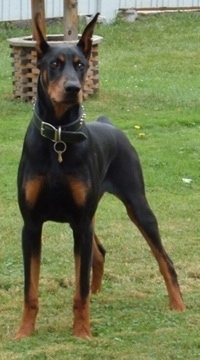
Romeo the Doberman Pinscher
Chihuahua, Doberman... Chihuahua, Doberman... While it may seem less of a big deal for the Chihuahua to display this type of dominant behavior, IN A DOG’S MIND there is no difference between a Chihuahua doing this and a Doberman Pinscher or German Shepherd exhibiting this behavior. Yet a large percentage of small dogs are allowed to display this behavior.
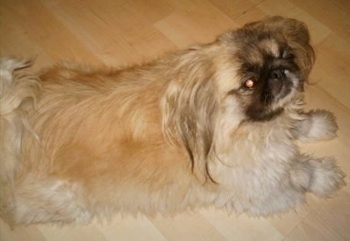
Luna the Pekingese
If someone were walking a 7-pound Pekingese and it was pulling on the lead as hard as it could to get near a tree to pee on it, most dog walkers would simply hold the lead and allow the dog to pull way out in front. What's the harm? The dog is not strong enough to knock a person down and you know you have a good grip on the lead, right?
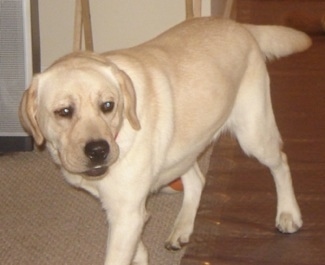
Chanel the Labrador Retriever
Whereas if a 70-pound Labrador Retriever were pulling you as hard as it could, there is a good chance it may just drag you across the pavement. Large dogs are more likely to be told to behave on a lead than little dogs. However, even most large dogs do not walk properly on a lead. Most dogs (large and small) take their owners for a walk (in front of the human) when they should be beside or behind them (pack leader goes first). Large dogs are, at the least, mostly taught not to pull. Whereas not only do small dogs walk out in front, they also pull without being corrected. Dogs that act very excitedly when their humans come home are showing signs of a lack of exercise and/or leadership. For a dog, excitement does not indicate happiness. In most cases, it is a sign of an unbalanced state. When you come home after being gone, avoid speaking to your dog in an excited manner. If we see dogs as human, a dog not being excited and happy does not make sense. However, we must remember dogs are canines, not humans.
Bella, the 7-pound Malti-Pom: "She's very quiet and refuses to sleep at the end of the bed. She wants her head on the pillow, and her body under the covers right in between us!"
Large and medium size dogs are less likely to be allowed to sleep at the top of the bed next to a person's pillow. There simply is not enough room for both human and a large dog. If a large dog is allowed on the bed, the dog will often be told to sleep at the foot of the bed. Small dogs are more likely to be allowed to sleep right on a human's pillow. In the dog world, the pack leader sleeps in the highest (height-wise), most comfortable place. And for those very tiny dogs that cannot jump on the bed themselves, they get to bark and TELL THE HUMAN when to put them on the bed and when to take them back off the bed. In a dog's mind only the pack leader tells others what to do. It is not necessarily a bad thing to allow your dog to be on your bed, so long as YOU are deciding when it can get on the bed and when it needs to get down. Just keep in mind in the dog world, the pack leader sleeps in the most comfortable spot, so do not allow your dog to push you out of your spot. Your dog needs to lie around YOU, not you around HIM.
While some dogs have more of a tendency to get yappy, the yappy traits have everything to do with the way they are treated by the owner. For instance, if the dog lacks a pack leader and feels IT is the pack leader it may become yappy every time you leave it alone, or become yappy as it tries to get YOU to follow ITS commands.
If you fall into the "Small Dog Syndrome" and allow a dog to take over the home, it will tend to be more yappy. Small dogs that see their humans as 100% pack leader and are told to hush when they do bark, get daily walks and are content with themselves are less likely to be little yappers.
When dogs appears scared, nervous, stressed, or otherwise upset in any way, we humans tend to pet them, stroke their coats, and talk to them in a soothing manner. We tell them everything is OK. We do this with both large and small dogs, but we tend to do it even more with the smaller dogs. We pick up the little dog and cuddle it every time it looks upset. We humans feel good about giving this type of comfort; it's human nature and our little dogs are our babies.
This type of reassurance works on humans, it's what humans do and we understand this type of comfort. However, when the canine animal is in an unstable state of mind and is given a human consolation (treated like a human) it intensifies the dog's state (stress, fear, nervousness, etc.). In the dog world when a dog is in an unstable state and you try to reassure it by giving affection, the dog sees you as being in a weaker state than its own. The canine species can read human energy. They read sympathy as weak energy. With their primal instinct to have order in the pack, it is very disturbing for a dog in a weak state of mind to be surrounded by other weak pack members. At these times there is no pack leader and chaos is present as no one is providing direction. (The same is true in ALL human societies. That is why leaders are elected or allowed to be in place.) It intensifies the dog's instability, sometimes to the point where the dog, in its already unstable state, tries to be your pack leader. In the dog's mind you are now weaker than it is, which instinctually puts the dog in a higher position than you. Instinct tells a dog that the stronger member is higher in the pack order. This ensures the pack’s survival. You need to give off a stronger, more stable energy that the dog can feed from.
Many little dogs suffer from instability due to their likelihood of being babied and over-protected. When large dogs are upset, since we cannot pick them up, they are less likely to be treated in this manner.
Dogs that believe they are the pack leaders often develop separation anxiety. Followers are not allowed to leave the pack leader but pack leaders can leave the followers.
Besides the obvious guarding, growling and biting, many dogs display a variety of dominant behaviors that commonly go unrecognized by their humans. Dogs very rarely display the highest level of dominance overnight. There are usually signs leading up to it over the years and dominant alpha dogs do not always growl and bite. If the owners are giving the dog what it wants, sometimes there is no reason for the dog to growl or bite unless it is challenged. Dogs understand that they exist in a human world. After all, who gives them food and opens the door for them to go potty? When humans perform these tasks on demand from the dog though, why wouldn't the dog think it’s the leader? It is easy for dogs to get the impression they are alpha in their pack. Since many canine alpha behaviors are not acceptable in human society, for example, biting, it is important for humans to retain their leadership over their dogs.
Below are some common behaviors dogs display when they believe they are above humans. Keep in mind that a dog does not have to display all of these behaviors to be in a dominant frame of mind. Sometimes an alpha dog will only display a few of the behaviors at random times, depending on what the dog decides it feels like doing at any given moment. Smarter dogs tend to challenge the pack order more than dogs of average or below-average intelligence.
Not liking to be left alone and getting overly excited upon the human’s return (see Separation Anxiety in Dogs)
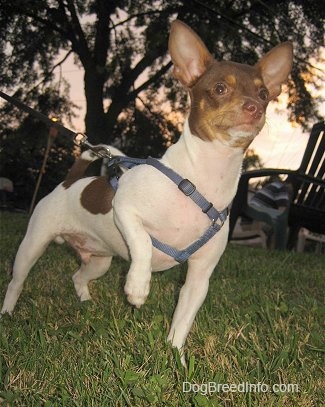
Just looking at a dog and the way he carries himself can tell you what frame of mind the dog is in. For example, a dominant dog will walk high and proud, puffing himself out as much as he can. He carries himself with what looks like dignity to the untrained human eye. The body is carried stiffly, tail is up and rigid, ears are on alert.
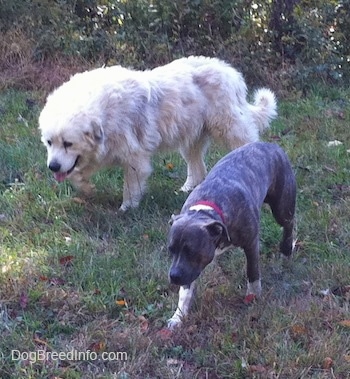
Submissive dogs, on the other hand, carry themselves in quite the opposite way. They hold their heads low, shoulders down, tails down, slinking themselves smaller. To the untrained human eye it looks like a submissive dog is a sad dog. Not so, the posture of these submissive dogs is telling all around them that they do not wish to challenge anyone. They come in peace. Dogs are “fight” animals, which means their natural defense mechanism is to fight when they are threatened. That is why they make it so obvious when they do not wish to fight or when they do.
Since dominant dogs look so proud and, we all have to admit, cute, if you don't know what the dog is really saying, and submissive dogs kind of look sad since they hold their heads low and slink themselves down, it's no wonder so many people have dominant dogs. When their dog acts submissive they mistake that for a sad dog. When their dog acts dominant they mistake it for a happy, proud dog. Dominance tends to get rewarded.
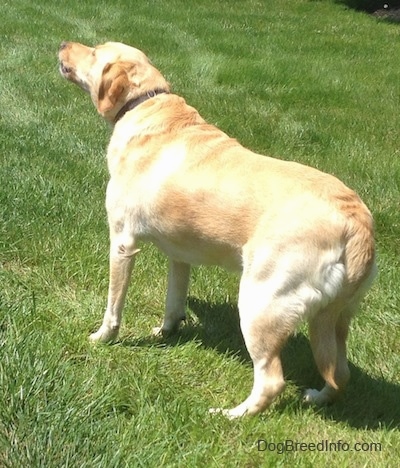
This yellow Labrador was growling and barking ferociously at a lady. The dog at one point trapped the lady in the corner of the garage until the owners were able to come and call her off. Most people would mistake this behavior as dominant-aggressive, but if you look at the dog's body language you will notice it is different than the Chihuahua shown above. The dog's tail is down and slightly tucked. The ears are back rather than forward. Notice how the dog is leaning slightly backward, rather than forward. This Labrador is insecure and fearful and she has learned to deal with these feelings by acting out aggressively. This dog may still bite a human out of fear, but the reasons for her behavior are not the same as a dog who is acting aggressive out of dominance.
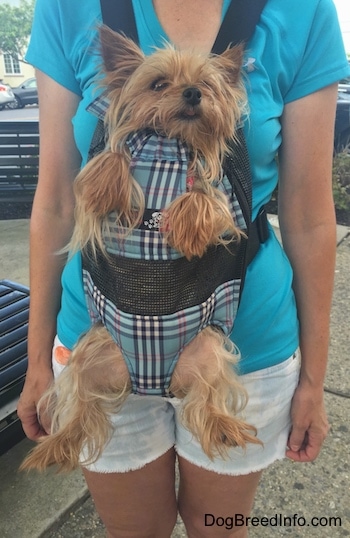
Mandy Mae the rescue Yorkie at 4 years old being carried in her pack.
The bottom line is small dogs are no different than large dogs. What gives them their different temperaments is that humans treat them differently. We carry them around, overprotect them and treat them like babies. Things we do not allow large dogs to do because of the dog’s size are never addressed with the smaller dogs. These are issues all dogs need to have addressed, yet the smaller dogs tend to not get this discipline.
If you are unsure how to gain control back from your dog, or if you think you are at risk of being bitten, please hire a professional to help you before you give your dog to a shelter. This commonly sentences them to Death Row. This will (or at least should) cause you to feel remorse and guilt that you will have to deal with (to varying degrees) for the rest of your life.