
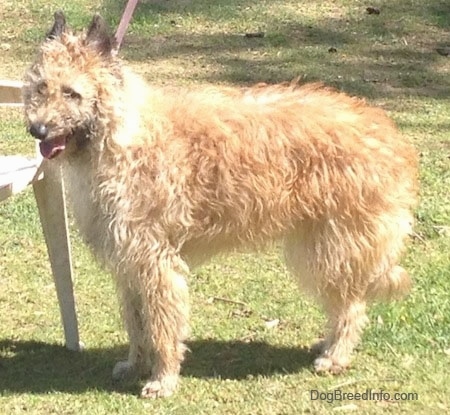
Mia the Belgian Laekenois at 3 years old
bel-juh n LAK-in-wah
The body is sturdy and well proportioned, with a squarely shaped appearance when viewed from the side. The erect ears are triangular in shape, with the height equal to the width, and set high on the head. The moderately pointed muzzle is parallel to the topline of the skull and tapers, but is not excessively pointy. The muzzle and head are fringed, giving the dog a shaggy, woolly look. The medium sized, almond-shaped eyes are dark with rims that contrast with lighter colored hair. The hindquarters are muscular without looking heavy. Dense hair is bushy on the tail, but there is no distinct feathering. The chest is deep, reaching to the elbow. The front legs are very straight, parallel and vertical to the ground. The round feet are cat-like in appearance. Dewclaws are usually removed. The long tail is thick at the base and reaches at least to the hock. The nose is black and the lips should be tight. The teeth should meet in a scissors or level bite. The Laekenois's medium length rough, wire coat covers the body in hair that can reach over two inches. Colors include a range from fawn to mahogany with a black overlay.
The rarest of the four Belgian Sheepdog breeds, the Belgian Laekenois is a very bright and obedient dog. It is determined and observant with strong protective and territorial instincts. Socialize well to prevent it from becoming shy or sensitive. Belgian sheepdogs need an experienced master who is firm, but not heavy handed. If you are harsh or overbearing they will become uncooperative. Owners need to display a confident, natural authority over the dog. Consistent rules must be set and made clear. This breed is instinctively protective so it should be trained and socialized very well from an early age. Puppies should be socialized right from birth. Good for working and competition obedience, these dogs make excellent police and guard dogs. This type of work is currently their main occupation. They do however, make excellent pets if they have owners who can challenge their minds with an air of leadership. They are ever watchful, alert and loyal. The Belgian Laekenois is good with children if socialized well with them. This breed needs to be part of the family and not locked up in a kennel. They need leadership, daily exercise along with training and companionship, for without it they may become destructive and hard to handle. The Belgian Laekenois is high energy, with a high mental capacity and is quick to comprehend. They need a job to do, especially if you are dealing with working lines. Take care when introducing this dog with small non-canine pets. They can be rather dominant toward other dogs and need an owner who can communicate to the dog that dominance is an unwanted behavior. Provided they are correctly socialized with cats and other pets, they should not present any problems. The Belgian Laekenois may instinctively display herding behavior such as chasing and circling, moving effortlessly for hours and nipping at people's heels. They must be taught not to do this to people. This is a very demanding dog. It needs an experienced owner for it can easily be difficult to control unless the owner knows how to handle him. The way the owner handles the dog can produce wide differences in temperament and aggressiveness. Talk to someone experienced with the breed before you buy your dog. These dogs are often impressive; don't base your purchase solely on achievement records and appearances. Only adopt this type of dog if you fully understand what it means to be alpha.
Height: Males 24 - 26 inches (61 - 66 cm) Females 22 - 24 inches (56 - 61 cm)
Weight: 55 - 65 pounds (24 - 29 kg)
This hardy, healthy breed has no major health concerns. Some minor concerns that have been seen are skin allergies, eye problems, excessive shyness, excessive aggressiveness and occasionally hip dysplasia and elbow dysplasia.
The Belgian Laekenois will do okay in an apartment if it is sufficiently exercised. It is moderately active indoors and will do best with at least an average size yard. This breed prefers cool climates, but adapts well to others. It can live outdoors but would much rather be with his people.
This is a working dog that is accustomed to an active outdoor life. As such it needs a lot of exercise, including a long daily walk. In addition, it will greatly benefit being off the leash as much as possible in a safe area.
About 12-14 years
Average 6 - 10 puppies
The rough, wiry coat of the Laekenois needs to be trimmed about twice a year, depending upon the quality of the coat. Dead and excessive hair should be removed. Resist suggestions to have your dog close trimmed as this ruins the coat for several years. In addition to the occasional light trim, use a coarse-toothed comb for grooming. The fawn-colored coat is harsh, dry and normally slightly tangled. It should be rough-looking but never curled. Bathe only if it is absolutely necessary, as bathing removes the waterproofing of the coat.
The Belgian Laekenois is the rarest of the four varieties of the Belgian sheepdogs. The dogs are the Belgian Laekenois, Belgian Groenendael, Belgian Malinois, and the Belgian Tervuren. All of the dogs share a common foundation. In most countries and breed clubs all four dogs are considered the same breed with different varieties in coat types. All four dogs share a breed standard in all countries except for the AKC, which since 1959 recognizes them as separate breeds and does not recognize the rare Laekenois at all. The UKC, which is also a U.S. registry, does recognize all four varieties as one breed. Versatile and highly intelligent, all four varieties of the Belgian sheepdog excel at a variety of talents, including but not limited to, police work such as, narcotics and bomb detection, protection and Schutzhund, search and rescue, also obedience, agility, tracking, herding, sled and cart pulling and as a guide for the blind and assistant to the disabled. These high energy, extremely intelligent dogs need leadership, to be challenged, and well exercised daily and therefore are not for everyone, but can make an excellent family companion with the right owners. The Belgian Malinois was the first of the four sheepdogs to establish type. Until the other four were established in type they were called "Berger Belge a poil court autre que Malinois," which means "Belgian short-coated Sheepdog who is not the Malinois." Today all four sheepdogs are popular in Belgium, with the Laekenois and Malinois more often used as working type dogs, than the Belgian Groenendael and Tervuren, but all types still making excellent workers.
Herding
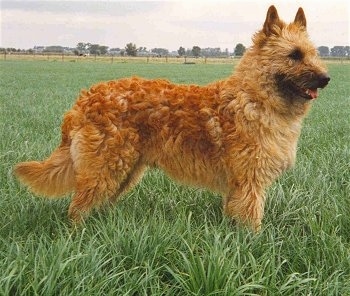
CH International, Belgium, Dutch Pierrewit van Kriekebos
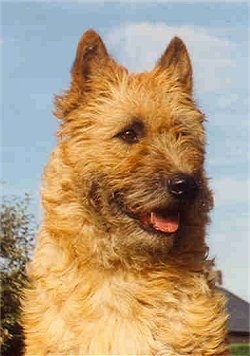
CH International, Belgium, Dutch Pierrewit van Kriekebos
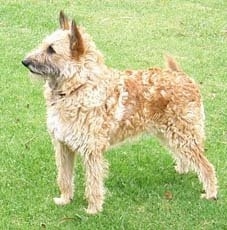
Belgian Shepherd Laekenois, owned by Miss Karen Edwards (Australia) BISS Australian Ch Lanaken Ruff N Ready (IID) (HIT)
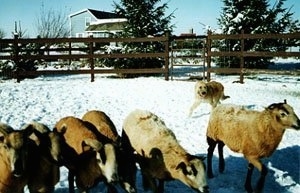
Sprout, Unite' des Fauves de Saline shown working sheep. Owner: Sonja Ostrom. Breeder: Christine and Bernard Rie. Sire: Bel. Ch. Opiun van Kriekebos. Dam: Bel. Ch. Qwini van Kriekebos. Photographer: Kathy Champine
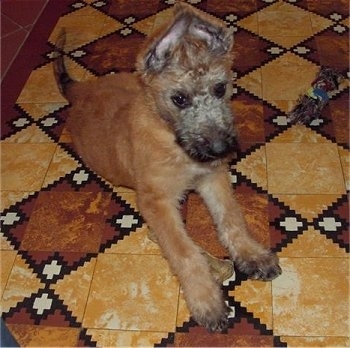
Troubles of Inka the Belgian Shepherd Lakenois puppy at 10 weeks old