
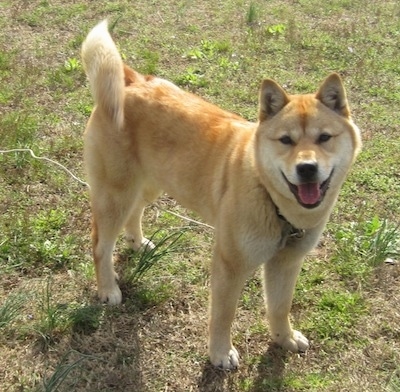
Angela the Jindo
--
The coat of the Jindo comes in white, yellow, red, red and white, tan, tan and white, black, black and tan, and brindle.
The Jindo is a medium-sized spitz-type dog that originated from the Jindo Island in Korea. Similar in appearance to the smaller Shiba Inu and the larger Akita, it was originally bred for hunting game as small as rodents to as large as deer. Almost all Jindos possess strong wills (even the ones that seem deceptively compliant) and have independent minds. They love to roam and are quite the free spirits. They tend to be the dominant type, trying to get things their own way, and can be very protective of their loved ones and territory. Because of these traits, Jindos are not recommended for inexperienced owners. Like most independent breeds, they need (and thrive under) firm but loving handling and consistency. Owners need to set the rules and stick with them. An owner who has earned the respect of his/her Jindo will be rewarded with unsurpassed loyalty and obedience. As with all breeds, the Jindo temperament varies with the quality of breeding and environment. The typical Jindo is very affectionate with its loved ones and reserved with strangers. A typical Jindo will not show affection toward people it has just met. At its most expressive, it is friendly in a gentle way. It is an excellent watchdog and will guard the home and family to the death if necessary. Early socialization to friendly strangers, other dogs, cats, and especially children is strongly recommended because Jindos are instinctively protective and have high prey drives. Because of their prey drives, they are usually not reliable around smaller animals such as hamsters and rabbits.In Korea, there are no leash laws and Jindos are allowed to roam freely. Their only aggression seems to be directed at other dogs and only as a means of establishing dominance or territories.
Height: Males 18 - 25 inches (48 - 65 cm) Females 16 - 22 inches (41 - 58 cm)
Weight: Males 35 - 50 pounds (16 - 23 kg) Females 25 - 40 pounds (11 - 18 kg)
The Jindo is a relatively healthy dog. Hypothyroidism can be a problem.
The Jindo should be allowed to live indoors with the family as opposed to being relegated to the yard where he might get into mischief out of boredom or loneliness. Jindos have been known to scale walls or fences that were 8 feet high. As independent as he is, his first desire is to be with his owner. As long as they are sufficiently walked, Jindos can be pleasant apartment dwellers due to their natural fastidiousness. Jindos will groom themselves like cats to keep themselves clean. They are very easy to housetrain.
Jindos need room to move. These dogs love to roam and investigate their territory (which, to them, is fairly expansive). Unless well trained on recall, it is highly recommended that Jindos be walked on lead at all times because of their prey drive. A minimum of two daily, 30-minute brisk walks are necessary and should be enough to keep a Jindo happy. While on the walk be sure to not allow the dog to walk in front of the human, as it is a canine instinct for the leader to go first. Although Jindos are not famous for their fetching abilities, they can be trained to fetch which is also an excellent form of exercise. Playing tug-of-war with a Jindo is not recommended unless the owner is assured victory.
About 12-15 years
About 4 to 8 puppies
The Jindo has a double coat that sheds heavily twice a year. During the shedding season, extra care must be given to the coat. Warm baths can help the process along. Daily brushing is necessary to remove the undercoat. Otherwise, be prepared for rolling tumbleweeds of undercoat.
The Jindo was originally bred on the Island of Jindo in southwest Korea several centuries ago. They were bred to hunt wild boars, rabbits, badgers and deer, working in groups or on their own. It is characteristic for the Jindo to bring down its prey, then to return to its owner to lead him/her to its catch. Jindos first started to appear in the United States in the 1980s. The Jindo is protected by Korean law as a national monument. Its legendary loyalty and affection for its master, fastidious nature, high intelligence and unfailing courage have made the Jindo the most popular breed of dog in Korea.
Since they were originally bred for hunting and helping their owners on farms, they could be considered a working breed.
AKC - Non-Sporting Group

Kobe the Jindo at age 5
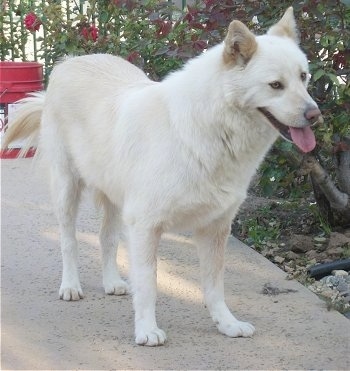
Heyou the whie Jindo
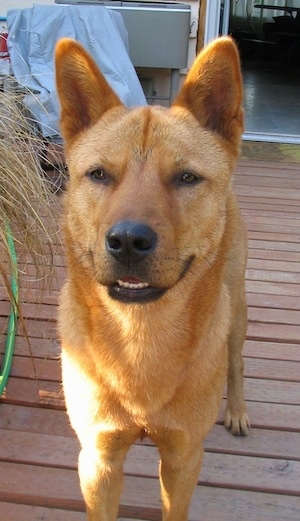
Steve the Korean Jindo
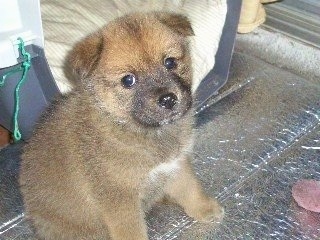
Victoria the three-week-old Jindo as a puppy
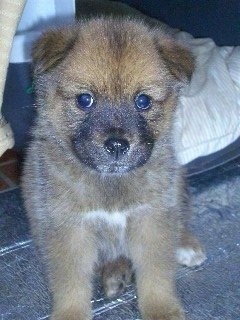
Victoria the three-week-old Jindo as a puppy
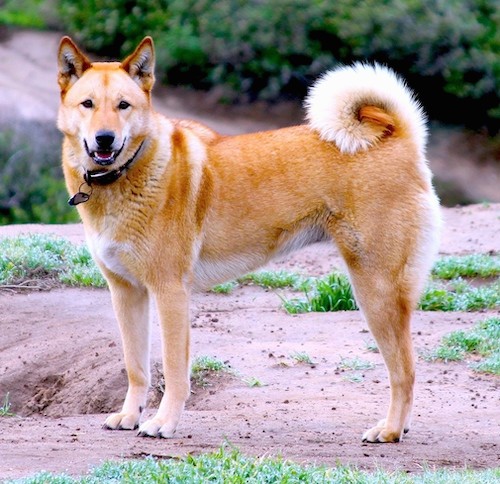
"Happy is an uber-alpha female Jindo in San Diego shown here at 4 years old. She is totally content and incredibly sweet and loving as long as her brother and sister know their places ... and the humans in her family keep her well fed, exercised and her teeth brushed! Nightly, she and her siblings launch hunting parties that have left the large, jungly backyard nearly devoid of wildlife. Happy accompanies, offleash, her owners on daily 5k jogs on the beach. But she's equally pleased to go on 30 minute leashed walks through the neighborhood. She still sees herself as the queen bee after 4 years: while her owners have trained her siblings to walk next to them, they have thrown in the towel on trying to teach that to this headstrong Jindo. But that's got benefits: when the owners are too tired to run the household, Happy is more than willing to assume that responsibility."
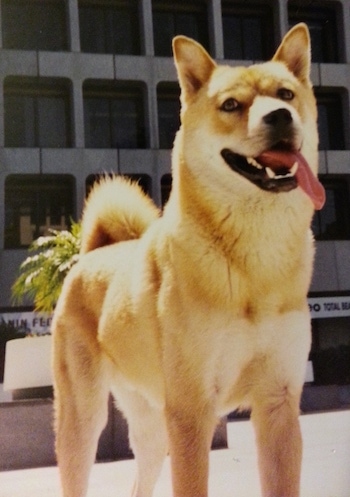
Kobe the Jindo - "Kobe was courageous and smart, loyal and respectful. Kobe was by far the best Jindo I have ever had the privilege to train and enjoy. He was the perfect specimen of the breed. In this picture you can see how well mannered Kobe was. I had him totally off the leash on Wilshire blvd. while taking a snap shot of him. We also took 3rd place in a Jindo dog show in LA back in 1998. Kobe and his mate Madala had one pup which you can see below. Miss that boy, the famous "Kobe the Jindo". However, now I have his granddaughter and she is just as beautiful."
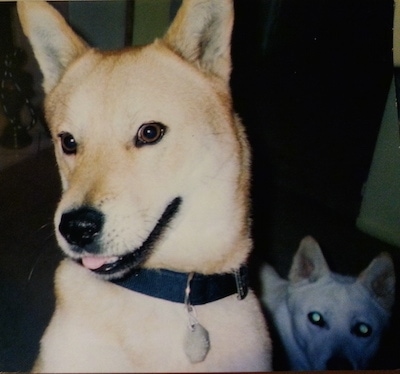
Kobe the Jindo in his younger years with his littermate Madala in the background.
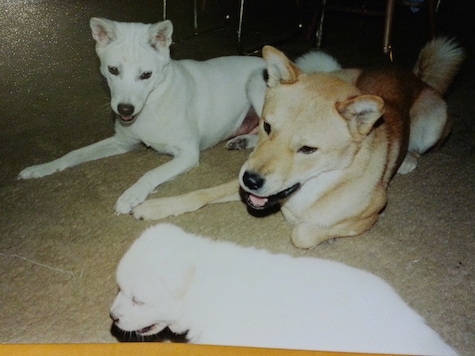
Kobe the Jindo with his littermate Madala and their puppy.
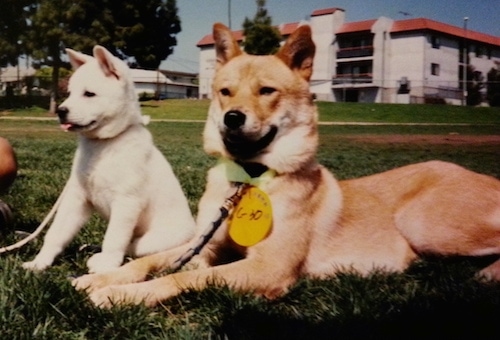
Kobe the Jindo with his puppy