
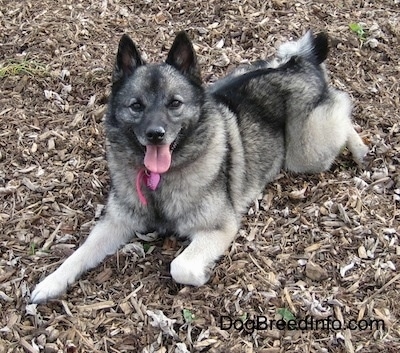
Tia the Norwegian Elkhound
nor-WEE-juhn ELK-hound 
The Norwegian Elkhound is a sturdy, medium-sized Spitz-type dog. The body is short and squarely built. The back is straight and strong. The wedge-shaped head is broad at the ears. The muzzle is thicker at the base, tapering but not to a point, with a clearly defined stop. The teeth should meet in a scissors bite. The medium-sized, oval-shaped eyes are dark brown. The ears are set high on the head, firm but very mobile. The chest is deep and relatively wide. The legs appear straight from the front. The oval paws are small and tight with thick pads. The tail is set high, tightly curled over the back. There are usually dewclaws on the front legs but not on the back. The weather-resistant, double coat is thick and hard. The coat is gray with black tips and a lighter undercoat and undersides with a black muzzle, ears, and tip of the tail. Norwegian Elkhound puppies are born black and turn gray when they are about a week old as their coat develops.
The Norwegian Elkhound is alert, bold, loyal and friendly. Although some may be somewhat reserved with strangers, it will greet family and friends it knows with enthusiasm. Docile, trustworthy and energetic, they are good child companions. Like other Arctic dogs, the Norwegian Elkhound has a mind of its own and is fairly independent, however it is affectionate with its family. They have an outstanding character, and are relatively clean compared to some other breeds. Can be somewhat difficult to obedience train. It is important to be firm with this dog, showing good pack leadership. They need firm, but gentle discipline. A natural watch and guard dog. This breed likes to roam and bark. They were bred to be hunters who hold their prey at bay, barking at it constantly until the hunter arrives. If their barking becomes obsessive they must be taught enough is enough after they alert you once, it's time to quiet down. Be fair when training this breed, and understand it is a canine, not a human and treat the dog accordingly. If they are not 100% sure of their follower place in the world they can develop a tendency to fight with other dogs. Elkhounds are hunters and should not be trusted alone with small non-canine pets such as hamsters, pet rats, mice or guinea pigs, however some have been known to get along with them when the owners worked at communicating to the dog that the small pet was alpha over them. They can get along with cats of the family. Without enough mental and/or physical exercise they can become high strung. Be sure to make the dog heel when on a walk beside or behind you, never in front, to reinforce the human is alpha over the dog; pack leader goes first.
Height: Males 19 - 21 inches (48 - 53 cm) Females 18 - 20 inches (46 - 51 cm)
Weight: Males 50 - 60 pounds (23 - 27 kg) Females 40 - 55 pounds (18 - 25 kg)
Prone to hip dysplasia, pyotraumatic dermatitis and PRA. Occasionally seen is Fanconi syndrome. Gains weight easily, do not over feed.
The Norwegian Elkhound will be okay in an apartment if it is sufficiently exercised. It is fairly active indoors and does best with at least a large yard. Elkhounds prefer cool climates.
The Norwegian Elkhound is a very energetic dog that thrives on strenuous activity. They need to be taken on a daily, long, brisk walk or jog. While out on the walk the dog must be made to heel beside or behind the person holding the lead, as in a dog's mind the leader leads the way, and that leader needs to be the human. It should have at least an hour of exercise a day. It will enjoy a running beside your bike or a really good run in the woods, but remember that these dogs like to roam. If they pick up an interesting scent, they may ignore you, or not even hear you when you call them.
About 12-15 years
About 5 to 10 puppies
The hard, coarse, weatherproof coat is easy to groom. It should be brushed regularly, with extra care given while the dog is shedding its dense undercoat. When the dog is shedding, the dead hair clings to the new hair. The dead hair should be removed with a rubber brush or a wooden comb with a double row of metal teeth. Brushes and combs just for this purpose are sold in pet stores. Bathe only when necessary, as it removes the natural oils in the skin. Like other Arctic dogs, they do not have the usual smell of dog hair. The coat is both water and dirt resistant. This breed is a seasonally heavy shedder.
The Norwegian Elkhound originated in Scandinavia and is one of the most ancient breeds; it is thousands of years old and has been around since the Stone Age. A skeleton similar to today's Norwegian Elkhound dating from 4000 to 5000 BC has been found. To put some perspective on it, these dogs have been around since man hunted with slingshots and lived in caves. They worked as a hunting and guard dog for the Vikings. The dogs were used as big and small game hunters tracking animals such as moose, elk, bear, mountain lion, badger, lynx, wolf, reindeer and rabbit. The dogs would track the quarry and alert the hunter by barking, holding the animal at bay until the hunter arrived. Norwegian Elkhounds can smell game from over a mile away. The dogs tended to work better at night than in the daytime. The breed is also highly prized as a sled dog. In case of war, the Norwegian Defense Minister has the power to mobilize all privately owned Elkhounds. In more recent times, the friendly and reliable character of the Elkhound has helped win a place in many homes as a cherished family pet. The name "Elkhound" is a direct translation from its original Norwegian name "Elghund," meaning "moose dog." In Norwegian, "elg" means "moose" and "hund" means "dog." The breed was first exhibited in 1877 when the Norwegian Hunters Association began holding shows. The AKC first recognized the breed in 1913. In 1923, the Elkhound Club was formed and the breed was officially recognized by the British Kennel Club. Some of the Elkhound's talents include: hunting, tracking, herding, watchdog, guarding, sledding and agility. There is also a Black Norwegian Elkhound that is recognized as a separate breed, but is almost identical in type except for color.
Northern, AKC Hound
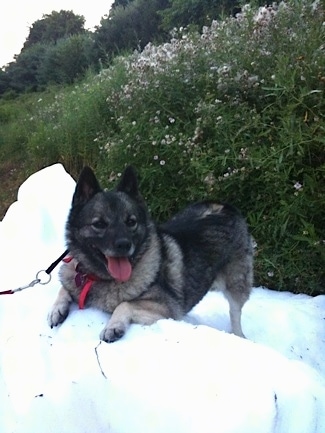
"Tia the Norwegian Elkhound was out on a walk with Bruno the Boxer. It was an 80-degree night and Tia was hot. We walked behind an ice skating rink and Tia spotted something that looked like heaven to her! A mound of snow scraped from the rink! Tia rubbed her nose all over it, rolling in the coolness. To her the snow on a hot day was better than horse poop!"
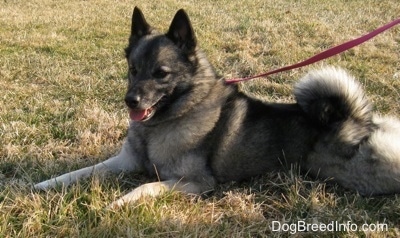
Tia the Norwegian Elkhound rescue at 4 years old laying in the grass
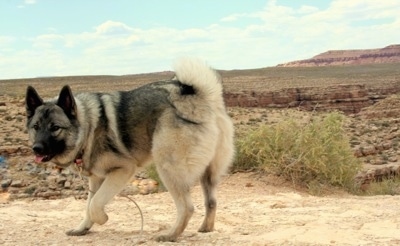
"Sophie, shown here as an adult, is a great Norwegian Elkhound. She has turned out to be an excellent companion and an all-around well-behaved dog. She loves climbing rocks and playing in the snow. Sophie lives in Canada and loves the cold winters. She will sleep comfortably outside in the snow at -30 degrees C (-22 Fahrenheit)."
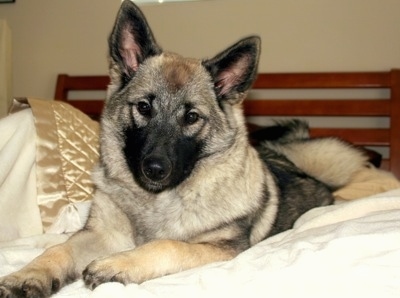
Sophie the Norwegian Elkhound as a puppy at 7 months old laying on the bed
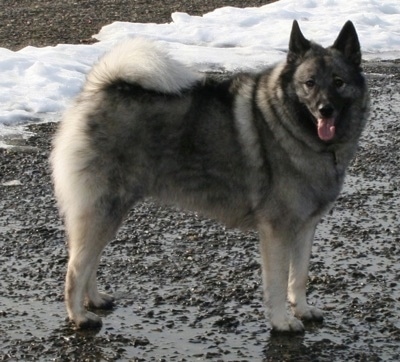
"This is Apollo, our 2-year-old purebred Norwegian Elkhound. Apollo comes from a champion bloodline. He is a loyal, affectionate dog, and thoroughly enjoys his non-canine family members (cats and ferrets). He has many of the typical traits of his breed, including being a fierce squirrel hunter and incessant barker when an unknown animal or human is on his territory. He is a fantastic watchdog, yet would never cause harm to anyone. He loves the snow, and runs around like a puppy dragging his open mouth in the snow during storms. He also loves to play in lakes and streams during the warmer months. He resides with us in central Massachusetts."
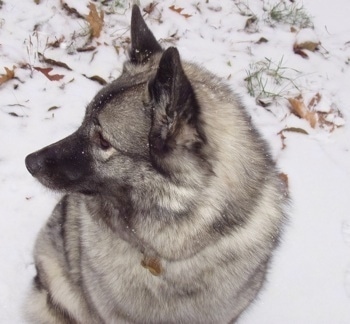
Apollo the purebred Norwegian Elkhound in the snow
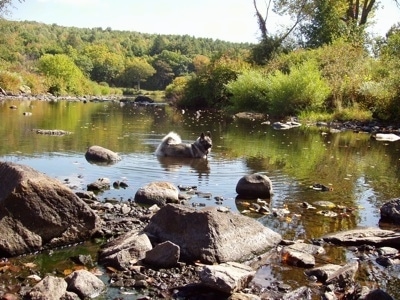
Apollo the purebred Norwegian Elkhound enjoying the water
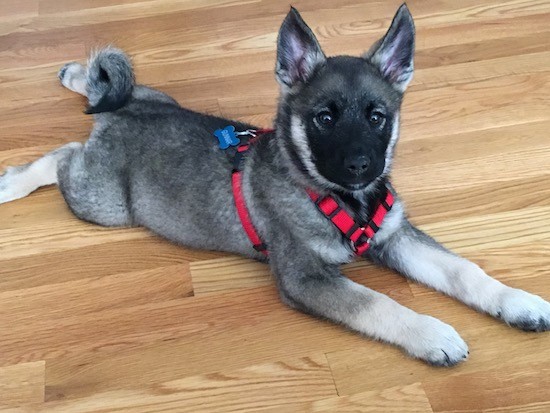
Gunnar the Norwegian Elkhound as a puppy at 3 months old—"Gunnar the Norwegian Elkhound is a super smart and energetic puppy, will do anything for a treat. We like to say that Gunnar is ALWAYS hungry and loves being with his humans! The only thing Gunnar loves more than chasing squirrels is sleeping on a pile with his humans. We are very happy to have this little fur ball join our family!"
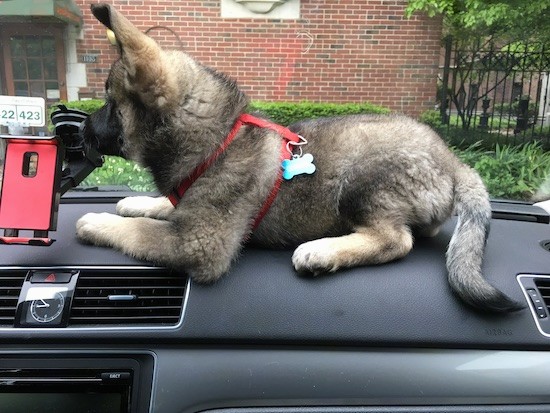
Gunnar the Norwegian Elkhound as a puppy at 3 months old
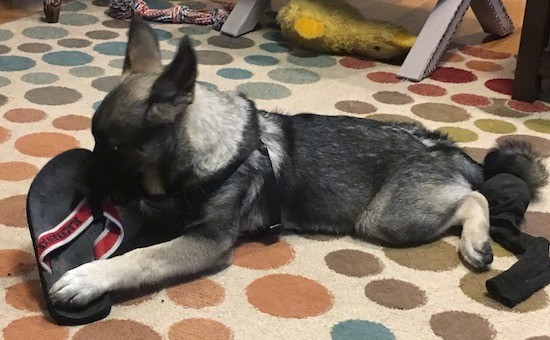
Gunnar the Norwegian Elkhound as a puppy at 3 months old