
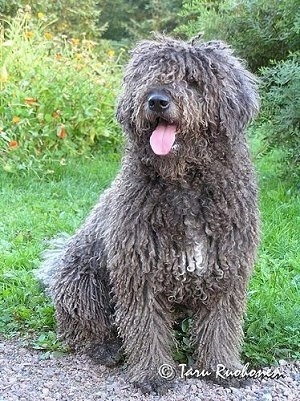
Photo courtesy of Taru Ruohonen, Finland
Span-ish Waw-ter Dawg
The Spanish Water Dog is rustic and well-proportioned of medium weight. The head is strong and carried with elegance. The skull is flat with only a slightly marked occipital crest. Axes of skull and muzzle are parallel. The nostrils are well defined. The nose is of the same color or slightly darker than the darkest one of the coat. The lips are well fitting; labial corners are well defined. The teeth are well-formed, white, with well-developed canines. The eyes are at a slightly oblique position, very expressive; of a hazel to chestnut color, should harmonize with the color of the coat. The conjunctiva is not apparent. The neck is short, well-muscled, without dewlap and well set into the shoulders. The body is robust and the topline straight. The withers are hardly marked and the back is straight and powerful. The croup is slightly sloping. The chest is broad and well-let down; ribs are well arched; diameter of thorax is ample, indicating considerable respiratory capacity. The belly is slightly tucked up. The tail is set at medium height. Docking must be done at the height of the 2nd to the 4th vertebra. Certain subjects show a congenital shortened tail (brachyouria). The forequarters are strong and vertical. The shoulders are well muscled and oblique. The upper arms are sturdy and the elbows are close to the chest and parallel. The forearms are straight and sturdy. The front feet are rounded, toes tight, nails of varied colors, resistant pads. The hindquarters are perfectly vertical with not too pronounced angulations and muscles capable of transmitting to the body a very energetic impulsion and the spring necessary for easy and elegant jumping. The upper thighs are long and well-muscled. The skin is supple, fine and well adhering to the body. Can be pigmented brown or black, or be without pigment according to the color of the coat. The same applies to the mucous membranes. The coat is always curly and of woolly texture. Curly when short, can form cords when long. The recommended maximum length of the hair for shows is 12 cm (15 cm extending the curl) and minimum is 3 cm to see the quality of the curl. Puppies always are born with curly hair. Colors include white, black and chestnut in their different shades. Bicolored: White and black or white and brown in their different shades. Tricolored subjects and black and tan, as well as hazelnut and tan dogs are not admitted.
The Spanish Water Dog is an extremely intelligent and well-balanced, versatile working dog with strong herding, hunting and guardian instincts. He is an exceptional companion, devoted to family, attentive and happy dog, showing strength and stamina combined with unusual agility. He is versatile and easily trained, performing his assigned tasks with competence and dignity. He is reserved with strangers but should not exhibit shyness. Although an authoritative worker, viciousness toward people or animals is intolerable. The Spanish Water Dog is a large dog in a medium body. It should be socialized at a young age with people and other small animals. Be sure you are this dog’s firm, consistent, confident pack leader to prevent it from becoming protective and territorial. Although it makes a fine companion and pet, the Spanish Water Dog (as any other dog) should never be left unsupervised with small children. Because of its high intelligence and working drive, this dog must be kept mentally and physically active doing something. Some of the tasks that the Spanish Water Dogs are used for are search and rescue, bomb detection, narcotics detection, herding, water sports, competitive agility, therapy work, etc. Teams of Spanish Water Dogs as rescue dogs were sent to Turkey, Mexico and Colombia after they experienced earthquakes.
Height: Males 17 - 20 inches (44 - 50 cm) Females 16 - 18 inches (40 - 46 cm)
Weight: Males 40 - 49 pounds (18 - 22 kg) Females 30 - 40 pounds (14 - 18 kg)
While the SWD seems to be a very healthy breed there are some issues that it has, just like all other breeds. There are cases of hip dysplasia in the breed, so choose your breeder carefully. All breeding dogs should have their hips tested, either by OFA or PennHIP. There have been a few cases of PRA reported in Europe so it is advised that all breeders should test their breeding stock for PRA and other such genetic eye diseases with a yearly CERF exam. A responsible breeder will be able to produce the results in writing. Like other Water Dogs and related breeds, they grow hair in their ear canals and can be prone to ear infections. The ears must be kept dry and clean. Because these dogs are (as a general rule) so active and energetic as puppies, they may seriously injure themselves from too much running and jumping when their skeletal structure is still developing.
The Spanish Water Dog can adapt to almost all environments or circumstances, as long as it gets enough exercise. These hardy dogs can endure both extreme heat and cold with no problem.
The Spanish Water Dog should get plenty of exercise, which includes a daily walk. These dogs are energetic and lively and are in their glory when allowed to romp and play. As young puppies (from 1 month to 7 months of age), their exercise should never be over-taxed, to avoid possible bone and joint problems later on, but should still be taken on a daily walk. They become more active and sleep less as they mature and by the time they are a year old, these dogs have endless stamina and are very fast, athletic and agile.
About 10-14 years
About 5-8 puppies
First, one must determine what duties the dog will undertake. Will it be used for herding, hunting, water-sports, agility or some other form of work, or will it be a show dog? As a working dog you might want to shear the dog often as the coat will hinder his work in the bush while hunting, the hair will be broken off on the branches in the woods thus causing him to have an un-kept look, however if you shear him down he will always look clean and neat. The SWD is a rustic working dog. The coat of the SWD should never be combed or brushed. When allowed to grow, the coat may form cords. To maintain the coat, bathe only when necessary, using a mild shampoo without heavy conditioners. During the bath, the coat should never be rubbed excessively; the soap should be worked through the coat as if washing a sweater. After the dog is allowed to shake, the coat may be blotted with a towel, never rubbed vigorously. Allow the dog to air dry, or use a crate dryer, never a blow dryer. The coat will naturally mat which is what forms the cords. If the coat becomes excessively matted, the cords can be separated by pulling the mats apart with your fingers down to the skin. For show dogs, the Spanish Water Dog should never be aesthetically groomed. The cords should never be trimmed. The coat should be sheared down at least once a year (or more if you prefer a shorter coat) using a #5 blade on the entire body which leaves 1/4 inch of hair, including the head and the ears. Once or twice a week one should look behind the ears and the area where he sits and with your fingers separate any cords that might bind together. Bathe as needed; drying takes some time. Consistent minimal work is needed to help develop the proper cording. The Spanish Water Dog does not shed its coat and is a single-coated breed. While this produces less dander, people with severe allergies should use caution. The Spanish Water Dog is a hypo-allergenic dog (meaning LESS allergies) but not a non-allergenic dog. Some people are allergic to the saliva and urine as well as the dander. If there are concerns about allergies, it is recommended that one spends time with the Spanish Water Dog to see if they are indeed allergic.
History of the Spanish Water Dog
By Antonio Garcia Perez and Sheryl Gaines
The Spanish Water Dog is an ancient breed. There are several theories regarding its origins, however, the exact origin is not known. One theory suggests that the Turkish merchants brought the dog to the south Iberian Peninsula along with the flocks of livestock as they moved throughout the Mediterranean. Another theory suggests North African origin. Regardless of its exact origin, there is documentation of a wooly coated Water Dog on the Iberian Peninsula in 1110 AD. It is generally accepted that these wooly coated dogs were the ancestors to the common trunk of water dogs.
The breed has been known by many different names, including, Perro de Agua, Perro Turco, Laneto, Perro de Lanas, Perro Patero, Perro Rizado, Churro, Barbeta and most recently Perro de Agua Español.
In Spain, the Water Dog was primarily used for herding sheep and goats. In the eighteenth century, a large company called “La Mesta” was responsible for moving livestock, including the Water Dogs, from south to north of Spain and back again searching for fertile grazing areas. This route was known as “Canada Real.” The movement of animals was known as “Trashumancia” Because of this, there were dogs working throughout Spain. When the French Napoleonic forces occupied Spain, the “Trashumancia” began to diminish. Spain’s Queen Elizabeth II’s Minister Espartero gave plots of land to farmers, including livestock and dogs to guard and herd the livestock. The French aristocracy admired the Water Dog and brought them back to Paris. There are paintings depicting French and Spanish Royalty with Water Dogs which can be seen in “La Palacio de Granja” in Segovia.
While the Industrial Revolution affected the north of Spain and Madrid, it “forgot” the Andalucians. While shepherds in other parts of Spain replaced their herding dogs with German Shepherd Dogs and Belgian Shepherds, the Water Dog remained in the southern part of Spain, especially Cadiz and the mountains of Malaga in Andalucia, due to its ability to work in the mountains. At the same time, in the ports of Seville, Algecieras and Malaga, the Water Dog was used to tow boats to shore. Later, when this task was no longer necessary, they were used in the northern part of the country to assist the fisherman with their nets.
The Water Dog was also used for hunting water fowl and upland game.
The fishermen in the northern part of Spain preferred the lighter colored dogs because they were easier to see in the water, so they primarily used white, beige and bi-colored dogs. The farmers preferred the darker colored dogs because they were easier to see in the pastures, so most of those dogs were brown or black.
The recent history of the breed began around 1980 when at a dog show in San Pedro, Malaga, a woman named Mrs. Mesdag brought a Spanish Water Dog to be shown as an Andalucian Breed. This show was organized by Santiago Montesinos Rubio and judged by RSCE judge David Salamanca Ortega. At the show, Antonio Garcia Perez, who was showing German Shepherd Dogs, saw the dog and told Mr. Montesinos and Salamanca that he has seen many of these dogs in Ubrique and surrounding areas (Andalucia) and always wondered why he could never find the breed in any dog book, as they were with his family as long as anyone could remember. Santiago Montesinos, who was from Estepa (Seville), also remembered the dogs from his youth. Antonio Garcia asked Mr. Salamanca and Mr. Montessinos to help him get the breed recognized, and they agreed. The first thing they did is request photographs and any records that might be available. Santiago Montessinos Rubio then formed Club de Perro de Agua and designed the logo. He came to Ubrique and surrounding areas, using his own money to take photographs and study the breed. He sent many letters to the RSCE (Central Kennel Club of Spain), but got no response.
In the summer of 1983, Antonio Garcia Perez met with the Ministry of Agriculture, bringing many photographs and Super 8 film, to discuss the standard for the breed. The standard that he initially wrote and presented was for two different sizes of Spanish Water Dogs, but they would not accept this, so the official standard was made into one with a larger range of sizes. It was based on a dog named “Lucky” owned by Antonio Morena. It was accepted by the Ministry of Agriculture. In the fall of that same year, at the Madrid World Dog Show at Hipodromo de la Zarauela, two brown dogs were shown, one male and one female. The President of the Spanish Government, Mr. Filipe Gonzalez was in attendance at the show. He told the President of the RSCE, Mr. Valentin Alvarez that he knew the breed because he had seen them in South Andalucia where he grew up. Antonio Garcia Perez promised Mr. Gonzalez a puppy once the breed was officially recognized.
On May 19, 1985, at the Madrid International Dog Show, held at Retiro Park, 47 Spanish Water Dogs were shown to be registered for the first time. There were 42 dogs from the south of Spain and 5 from the north. Due to all the dogs not meeting the standard, for example some were albino or had the incorrect bite, about 40 dogs were registered. The breed was officially recognized by RSCE and put into FCI Group VIII (flushing dogs) Section 3 (water dogs). The PDAE was provisionally recognized by FCI until 1999 when it received full recognition.
On September 6, 1986, Antonio Garcia Perez presented a male puppy to Mr. Gonzalez at the Palacio de LaMoncloa. The dog was a brown dog called “Rabon,” born with a natural bobtail. A few days later, the first “Monografica” was held in Ubrique with 27 dogs and was judged by Mr. Marquez de Parales. Best in Show was a brown male named “Marquez Chocolat.” Best of Opposite was a females called “Mori.”
The Spanish Water Dog can still be found working in the mountains of southern Andalucia herding goat and sheep as they have been for the last 1000 years. They are also used for many more modern tasks such as Search and Rescue and bomb sniffing by the Spanish government.
The Spanish Water Dog was officially recognized by the AKC in 2015.
Sporting, Herding
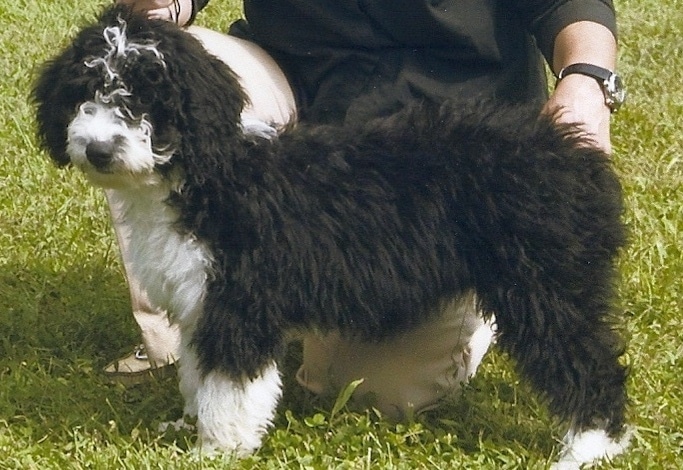
"Casa de Rancho's Mona, age 6 months, has won a total of 13 Best Puppy in Shows and is Rarities/NAKC Top Puppy of 2009." Photo courtesy of Casa de Rancho
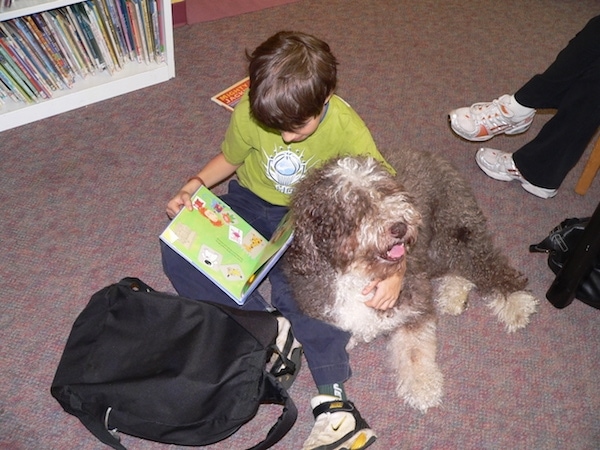
"Here is Multiple BIS, Multi Champion, Rancholunac de Ubrique doing one of his jobs in the "Reading to Dogs" program at the local library. The program is to help children who have difficulty reading out loud boost their confidence by reading to a non-judgmental audience. Rancho is a wonderful therapy dog."
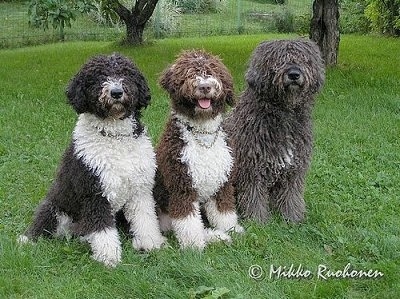
Photo courtesy of Taru Ruohonen, Finland
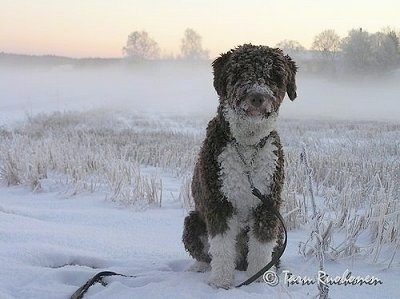
Photo courtesy of Taru Ruohonen, Finland
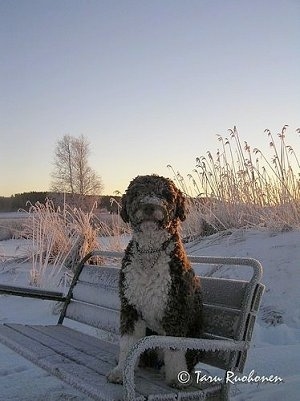
Photo courtesy of Taru Ruohonen, Finland

E CH Lasthorg de Ubrique
Photo courtesy of Taru Ruohonen, Finland
Owned by Antonio Garcia Perez
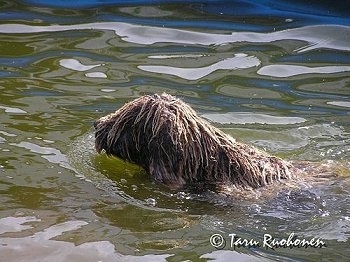
E CH Lasthorg de Ubrique
Photo courtesy of Taru Ruohonen, Finland
Owned by Antonio Garcia Perez
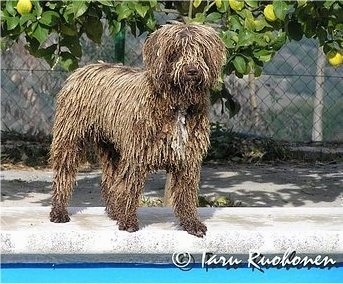
E CH Lasthorg de Ubrique
Photo courtesy of Taru Ruohonen, Finland
Owned by Antonio Garcia Perez